Showing posts with label Banksy. Show all posts

Friday, March 10, 2017

Hello, back again, for Banksy....

At 6:30 last Friday morning I was waiting for the BBC to contact me with details about Banksy’s latest project – a hotel in Bethlehem, named the “Walled-Off,” facing the West Bank barrier wall, with "the worst view in the world." The day before I’d received an email with the heading “BBC NEWS-URGENT” (which, like most messages that say URGENT nearly went into the spam folder) and had agreed to comment on it live at 9:30 in their studio at 200 Liberty Street. When I got there (found a taxi, whew!), finally passed Pentagon-like security and arrived on the 18th floor, I was greeted by a beautiful woman named Kizzy. She took my coat, gave me a plastic cup of water, and immediately ushered me into the sound room—a padded cell with a wall-size green screen and projected view of Manhattan. In front of the screen was a desk and chair, with an eerie camera lens embedded in the opposite black wall. To the right was a big monitor with me, only me, on it (if you think looking into a magnified mirror is scary, try HD!). Kizzy wired me up and left, closing the door. I fluffed my hair in the monitor. In my ear I could hear an announcer, parts of the news program, and a lot of interference. A British male voice came on, asked me to say something to test the volume, and told me we’d be live in seven minutes. I still had only the barest information about Banksy’s project and no idea what I’d be asked.


I did fine. Interspersed with my comments were those of a male British critic with a sonorous voice, clearly an experienced presenter (I never caught his name), who did even better. Kizzy came in, unwired me, gave me my coat and I went out into the sunshine, off to tea in Tribeca with my friend, Elenor.


More images here:

Saturday, October 3, 2015

Bristol Graffiti Tour

One of the things I appreciate about nature is that there’s no advertising. Even more, except for trail markings, some artfully piled rocks, the rare piece of litter and the flag at the top of the mountain, when I hike in the woods I don’t have to come in contact with anyone else’s sensibilities.

Then there’s New York, which is nothing but other people’s sensibilities, all vying for my attention. The idea that advertisers get to shape the human environment is one of the worst outcomes of unfettered capitalism. Do I really want to think about psoriasis when I’m on the subway? Or look at that guy in his Calvins high about Houston Street? We can’t avoid it, advertising is everywhere, on every possible bit of real estate including the risers on station steps, and we accept it with no complaints—but when someone presumes to write his/her name on a wall with a marker, everyone goes apeshit.

Art or not, at least it’s the sign of a real person, someone who’s not trying to sell me anything, just letting me know s/he was there.


So what would the world look like if the graffiti artists were to prevail? It would look like Bristol, England, which I visited on my trip to Banksy’s Dismaland (more about that in a later post):


Banksy's "Mild Mild West" next to The Canteen, which advertises itself as "responsible, delicious, and noisy", and where we had roasted duck salad with celeriac root fries. Those street artists eat well!


Work by friend, PETRO, who was our guide.


And I love these little whimsical bits you could easily miss. Later we went to the opening at Fluorescent Smogg Gallery to celebrate more work by PETRO and others:


COSMOGG SECRET INSTALL - BRISTOL 17th September from Fluorescent Smogg on Vimeo.


All photographs by Carol Diehl © 2015


Monday, September 28, 2015

Banksy and the Problem of Writing about Humor You Don’t Get (Dan Brooks in the NY Times, Part II)


In a previous post I called out (and, I hope, shamed) Dan Brooks in his NY Times essay, “Banksy and the Problem with Sarcastic Art” for writing a negative critique of Banksy’s pop-up theme park, Dismaland, without bothering to actually experience it. Now I’d like to address another aspect of that piece, the fact that Brooks doesn’t get British humor, thereby offending an entire culture.

Before expounding, Brooks might have, like any good writer, consulted Wikipedia, where it says: “A strong theme of sarcasm and self-deprecation, often with deadpan delivery, runs throughout British humour.” This is a surprise? I thought humor was one of Britain’s most famous exports. But then Brooks lives in Montana.

So, of course, the Brits say it best, as evidenced by these comments on Brooks’s blog:

Patricia:  Hello your piece about Dismaland was a load of bollocks just saying .smiley face


Sam: Hey arsehole, I noticed you didn’t offer a right to reply on your hilarious Banksy critique you coward. American critics can’t seem to help but embarrass them selves when it comes to understanding British cultural work. The reason you can’t pin down where the depth lies in his work is because you can only see it through the lens of your own cultural experience you prick. Its not for you, (American goal/success obsessed, materialists), its for us, (British people who live under the yolk of class oppression). He’s made it clear he doesn’t want to be in the work and that’s a big part of its value. Just accept it. It’s Far more poignant and rare to see outward looking work like his, rather than most American introspective conceptual art that’s obsessed with the artist and the individual, that when you get down to it, exists as little more than in invitation to fuck or be fucked. Write about shit you see in your own culture but leave our work out of it.

           
Beaver:

 LOL. Takin’ some heat for your Dismaland piece. I guess that’ll happen when you deconstruct the only functioning tool in the room. And anyway, if you can thrill to the demagoguery, than surely you can at least find some amusement in the irony of a society which makes a bond of the chasm and defends it by hurling at you fragments of their smashed and deconsecrated urn, the last remaining ashes of wit mixing irretrievably in the wind with whatever comes next.


Dismaland, featuring "Mediocre" by Axel Void of Miami. Photo: Carol Diehl © 2015


Thursday, September 10, 2015

Banksy and the Problem with Writing About Stuff You Haven't Been To (Dan Brooks in the NY Times)


One of Banksy’s many talents is getting people in the public sphere to reveal themselves at their most self-serving. Like turning over a rock, his Dismaland has brought to light a gaggle of journalists (and/or editors, who goad them into it) willing to put their scruples aside and gain exposure by taking advantage of Banksy’s notoriety. I mean, really, you’d think that the first requirement of having an opinion on any experience would be to actually have the experience. But nooooo….first to tip me off to this phenom was a commenter who asked if the author of the negative Dismaland critique in the LA Times had actually attended it. Then in today’s New York Times Magazine, one Dan Brooks waxes at length on “Banksy and the Problem with Sarcastic Art.” citing negative reviews from Business Insider (“bad and boring”), HuffPo (“Dismaland is not interesting and neither is Banksy”) and others to bolster his point—while there’s no evidence that he, or any of the other writers, found occasion to visit the event. This conundrum is especially interesting when one considers that Brooks fancies himself a specialist in “ethical dilemmas” who, in his blog, has taken issue with those having an opinion about a book they haven't read.

Rats! I should have written a critique of the Jeff Koons retrospective, which I missed, based on my certain assumption that I would have hated it.

Is this happening relative only to Banksy or does it portend a trend? If so, it’s bad news for readers, good news for writers who will no longer have to leave their chairs to cover music, art, theatre, restaurants, etc. Think of the gas money they can save! And no need to get a baby-sitter. As for hard news, staying home is not only a lot safer than going into a war zone, the food is much better.


I’m off to Dismaland next week, will report.

***

Update: More on Dan Brooks's ethical dilemmas:
https://reptiledysfunction.wordpress.com/2015/09/12/some-thoughts-on-sarcasm/

Monday, November 17, 2014

"Banksy Does New York": Banksy and Hannah Arendt


The HBO documentary, “Banksy Does New York” reviews the anonymous British street artist’s month-long self-styled "residency" in New York where, in October of 2013, he generated a new work every day for a month, touching down in all five boroughs. In a brief segment of the film, I discuss the artist’s engagement with the writings of Hannah Arendt. The text is part of a lecture, “Banksy: Completed,” in which I follow his clues to reveal the philosophical origins of his work, given in the past year at University of Southern California/Fullerton, the Berkshire Museum, the University for the Creative Arts in Canterbury, UK and upcoming, Rochester Institute of Technology.
           ***

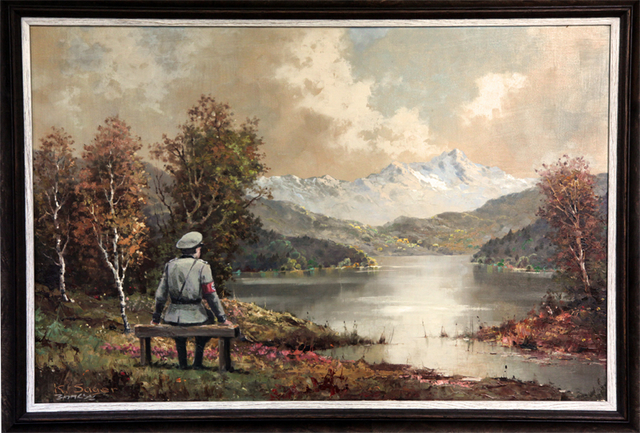
For Day 29 of his unsanctioned sojourn in New York, Banksy repurposed an original artwork, an overwrought pastoral oil painting purchased for $50 from a thrift store. With his painted addition of a solitary Nazi officer seated in contemplation on a bench, the scene of an autumn forest by a river with snowy mountains in the distance is transformed from kitsch Americana to Caspar David Friedrich-esque German Romanticism, the falling yellow leaves now signifying the decline of the Nazi regime as well as a warning, perhaps, of our own social and political decline. 

Scrawling his signature under that of the original artist, Banksy, on his website (which existed only for the duration of the “residency”), entitled the work "The banality of the banality of evil, oil on oil on canvas, 2013," and described it as "a thrift store painting vandalized then re-donated to the thrift store," with the intention that the proceeds go to the Brooklyn-based nonprofit that benefits homeless people living with HIV/AIDS. Housing Works auctioned it off and ultimately, after much bidding drama, netted at least $450,000.


On the Village Voice blog, writer Raillan Brooks no doubt Googled “the banality of evil” to discover that it was associated with Holocaust escapee and philosopher Hannah Arendt’s “theoretical reckoning of the Nazis' rise to power.” Brooks, concluded, however, that it more likely had “something to do with Banksy not really caring much about what he's actually saying”—when it’s clearly the theme that underlies all his subversive enterprises.

A Report on the Banality of Evil is the subtitle of Arendt’s 1963 book, Eichmann in Jerusalem, an eyewitness account of the Nazi criminal trial of Adolf Eichmann, who was accused of engineering the extermination of European Jews. Writing originally in The New Yorker, Arendt expressed shock that Eichmann did not come across as a monster, but “terribly and terrifyingly normal,” a man whose thinking was so conventional that he spoke only in clichés. This led Arendt to develop her thesis that beyond Hitler’s vile nature, it was the mediocrity of his functionaries, their unwillingness to think for themselves while attempting to fulfill their mundane needs and individual ambitions—hence their banality—that enabled the Nazi atrocities. Therefore Banksy’s title has to do with the original painting being itself a cliché, the work of a painter who is trying to please others rather than thinking for himself, and by inserting the Nazi officer, Banksy is adding a symbol of banality to banality, with his “oil on oil.”

While being tried as a war criminal, Eichmann insisted on his innocence: he never killed anyone or ordered that anyone be killed, nor did he have a grudge against Jews. He was a man eager to get ahead and his job, which he fulfilled efficiently, was to arrange for the transportation of Jewish prisoners to death camps. To do otherwise, he explained on the stand, would be to break the law at the time, and he was not a law-breaker. Their destination was not his responsibility. Upon hearing his sentence of death, Eichmann said, “I am convinced in the depths of my heart that I am being sentenced for the deeds of others.”


This concept is at the heart of Bernhard Schlink’s 1995 novel, The Reader, later made into a film. One of two main characters, Hanna, is being tried for war crime, but she’s not an officer, nothing like it, simply a guard who never considers the possibility that she could defy orders and unlock the burning church in which most of her prisoners die. Like Eichmann, what’s chilling about Hanna is her ordinariness; she’s just doing her job. Arendt suggests that evil is more accidental than intentional, less a result of ideology and conviction than a by-product of petty ambition and the drive for personal security.

Expanding on Arendt’s thesis was Stanley Milgram’s famous psychological experiment that measured the willingness of study participants to obey an authority figure who instructed them to inflict what they thought were electrical shocks on a hidden subject, an actor whose screams they could hear. Milgram concluded that, “Ordinary people, simply doing their jobs, and without any particular hostility on their part, can become agents in a terrible destructive process.... (When) asked to carry out actions incompatible with fundamental standards of morality, relatively few people have the resources needed to resist authority.”

Commenting on this experiment, Banksy has noted, “Garments are symbols of authority and we have a powerful tendency to accept authority….Take the man out of the doctor's costume and his test subjects refuse to do it.”

Ironically, while railing against this failure of humans to question their environment, Banksy consciously uses it to his own ends. Not one to skulk around in a hoodie, as he appears in his 2011 film “Exit Through the Gift Shop,” one of his methods for avoiding detection is to look as official as possible.  To “turn invisible” he recommends a high-vis vest, hardhat, clipboard, and business cards—not to speak of three stories of scaffolding under a CCTV camera.


It is therefore significant that Banksy’s Nazi officer is not depicted as an ogre, but a lover of nature, which makes him all the more normal and therefore frightening. In that context, Banksy’s entire crusade can be seen as one against what Arendt called a “failure to think” or, in other words, mediocrity and banality in all its forms.

The greatest crimes in the world are not committed by people breaking the rules but by people following the rules. It's people who follow orders that drop bombs and massacre villages. As a precaution to ever committing major acts of evil it is our solemn duty never to do what we're told, this is the only way we can be sure.
--Banksy, Wall and Piece.


Thursday, December 15, 2011

Events and non-events


By now everyone knows that TIME’s Person of the Year for 2011 is “The Protester” and that Shepard Fairey created the cover. Those who’ve followed this blog for a while know that I worked as a consultant for TIME on the covers for over 20 years, and introduced Fairey to TIME in 2007, when he created an image of Putin that ran on the inside (see post here).  While the Person of the Year, along with the magazine itself, no longer has much cachet, I’m still glad TIME made a good call (over, say, Kate Middleton for getting married or Steve Jobs for dying) as it represents formal recognition that this is a massive, worldwide movement—unlike the New York Times, which is still waiting for Occupy to go away so no one will notice that they haven’t been covering it.

I admire Shepard Fairey and feel his success is deserved; I have absolutely no patience with the kneejerk reaction that commercial success = sellout (Coldplay remains a favorite, and I’m glad Radiohead left their major label so they, too, don’t have to be a guilty pleasure). However, if I still worked for TIME, I wouldn’t have recommended Fairey for this cover simply because the protests represent the new and unknown, where his now-ubiquitous style is associated with the known, the past, and is simply too sleek and realized (again, nothing wrong with that per se) to represent the nascent, unformed and gritty surge that is this movement. If they’d asked, I would have looked for the street artist who is now what Fairey was in 2007. It's no one I could name off the top of my head. Because a TIME cover has very specific requirements, that would require the research that was once my job. I might, however, start here:


Although it’s had the Internet on fire for weeks and was a headline today in Britain’s Guardian, another event the New York Times (along with the rest of the mainstream media) hasn’t covered is the hasty passing—ironically on 220th anniversary of the Bill of Rights—of the latest iteration of the National Defense Authorization Act, which many feel compromises our most basic American rights to due process. But you can learn about it on the Huffington Post, and if you need a laugh to mitigate the fright, on The Daily Show.

Meanwhile, in the art world, I received a press release today announcing that Gagosian will be showing ALL of Damien Hirst’s dot paintings (they call them “spot” paintings) in ALL of the eleven Gagosian Galleries throughout the world—Paris, Athens, Geneva, Hong Kong, London, Rome and New York. Now there’s an event to stay home for. My opinion as a critic is, if you’ve seen one dot painting, you’ve seen them all. You can quote me.


Banksy's take on Hirst's dot paintings.