
Tuesday, June 28, 2016
Bill Cunningham and me
In 1993, on one of the most horrid hot humid days ever in New York, I was on Fifth Avenue with my Chinese paper parasol when a man with a camera ran up and snapped it in my face. I said, nastily, “You can’t do that” and he said, just as nastily, “I wasn’t taking a picture of you, I was taking a picture of Tiffany’s window behind you.” I walked about two more blocks before realizing that he was Bill Cunningham from the Times and when I got home, wrote him a short apology, saying that I mistook him for a rude tourist from Iowa. I forgot about it completely until several Sundays later when I was meeting a friend who had with her a copy of the Times—and there I was, in a layout about parasols, snarling under mine. That week I received a print of the picture in the mail and a note from Cunningham who wrote, “The image of you and your parasol turned me into an aggressive New Yorker…apologies. The tourists are the polite ones…it’s me who is not too polite. Best regards, Bill C.” – more gracious than I deserved.


Saturday, October 3, 2015
Bristol Graffiti Tour
One of the things I appreciate about nature is that there’s
no advertising. Even more, except for trail markings, some artfully piled rocks,
the rare piece of litter and the flag at the top of the mountain, when I hike
in the woods I don’t have to come in contact with anyone else’s sensibilities.
Then there’s New York, which is nothing but other people’s
sensibilities, all vying for my attention. The idea that advertisers get to
shape the human environment is one of the worst outcomes of unfettered
capitalism. Do I really want to think about psoriasis when I’m on the subway?
Or look at that guy in his Calvins high about Houston Street? We can’t avoid
it, advertising is everywhere, on every possible bit of real estate including
the risers on station steps, and we accept it with no complaints—but when
someone presumes to write his/her name on a wall with a marker, everyone goes apeshit.
Art or not, at least it’s the sign of a real person, someone
who’s not trying to sell me anything, just letting me know s/he was there.
So what would the world look like if the graffiti artists
were to prevail? It would look like Bristol, England, which I visited on my
trip to Banksy’s Dismaland (more about that in a later post):

Banksy's "Mild Mild West" next to The Canteen, which advertises itself as "responsible, delicious, and noisy", and where we had roasted duck salad with celeriac root fries. Those street artists eat well!


Work by friend, PETRO, who was our guide.


And I love these little whimsical bits you could easily miss. Later we went to the opening at Fluorescent Smogg Gallery to celebrate more work by PETRO and others:
COSMOGG SECRET INSTALL - BRISTOL 17th September from Fluorescent Smogg on Vimeo.

All photographs by Carol Diehl © 2015
Monday, September 28, 2015
Banksy and the Problem of Writing about Humor You Don’t Get (Dan Brooks in the NY Times, Part II)
In a previous
post I called out (and, I hope, shamed) Dan Brooks in his NY Times essay, “Banksy
and the Problem with Sarcastic Art” for writing a negative critique of
Banksy’s pop-up theme park, Dismaland, without
bothering to actually experience it. Now I’d like to address another aspect of
that piece, the fact that Brooks doesn’t get British humor, thereby offending an entire culture.
Before expounding, Brooks might have, like any good writer,
consulted Wikipedia,
where it says: “A strong theme of sarcasm and self-deprecation, often
with deadpan delivery, runs
throughout British humour.”
This is a surprise? I thought humor was one of Britain’s most famous
exports. But then Brooks lives in Montana.
So, of course, the Brits say it best, as evidenced by these
comments on Brooks’s blog:
Patricia: Hello your piece about Dismaland was a
load of bollocks just saying .smiley face
Sam: Hey arsehole, I noticed you didn’t offer a right to reply on your hilarious Banksy critique you coward. American critics can’t seem to help but embarrass them selves when it comes to understanding British cultural work. The reason you can’t pin down where the depth lies in his work is because you can only see it through the lens of your own cultural experience you prick. Its not for you, (American goal/success obsessed, materialists), its for us, (British people who live under the yolk of class oppression). He’s made it clear he doesn’t want to be in the work and that’s a big part of its value. Just accept it. It’s Far more poignant and rare to see outward looking work like his, rather than most American introspective conceptual art that’s obsessed with the artist and the individual, that when you get down to it, exists as little more than in invitation to fuck or be fucked. Write about shit you see in your own culture but leave our work out of it.
Beaver: LOL. Takin’ some heat for your Dismaland piece. I guess that’ll happen when you deconstruct the only functioning tool in the room. And anyway, if you can thrill to the demagoguery, than surely you can at least find some amusement in the irony of a society which makes a bond of the chasm and defends it by hurling at you fragments of their smashed and deconsecrated urn, the last remaining ashes of wit mixing irretrievably in the wind with whatever comes next.

Monday, September 21, 2015
Thursday, September 10, 2015
Banksy and the Problem with Writing About Stuff You Haven't Been To (Dan Brooks in the NY Times)
One of Banksy’s
many talents is getting people in the public sphere to reveal themselves at their
most self-serving. Like turning over a rock, his Dismaland has brought to light
a gaggle of journalists (and/or editors, who goad them into it) willing to put
their scruples aside and gain exposure by taking advantage of Banksy’s
notoriety. I mean, really, you’d think that the first requirement of having an
opinion on any experience would be to actually have the experience. But
nooooo….first to tip me off to this phenom was a commenter who asked if the
author of the negative Dismaland critique in the LA Times had actually attended it. Then in today’s New York Times Magazine, one Dan Brooks waxes at length on “Banksy
and the Problem with Sarcastic Art.” citing negative reviews from Business
Insider (“bad and boring”), HuffPo
(“Dismaland is not interesting and neither is Banksy”) and others to
bolster his point—while there’s no evidence that he, or any of the other
writers, found occasion to visit the event. This conundrum is especially
interesting when one considers that Brooks fancies himself a specialist in “ethical dilemmas” who, in his blog, has taken issue with those having an opinion about a book they haven't read.
Rats! I should have written a critique of the Jeff Koons
retrospective, which I missed, based on my certain assumption that I would have
hated it.
Is this happening relative only to Banksy or does it portend
a trend? If so, it’s bad news for readers, good news for
writers who will no longer have to leave their chairs to cover music, art, theatre,
restaurants, etc. Think of the gas money they can save! And no need to get a
baby-sitter. As for hard news, staying home is not only a lot safer than going
into a war zone, the food is much better.
I’m off to Dismaland next week, will report.
Update: More on Dan Brooks's ethical dilemmas:
https://reptiledysfunction.wordpress.com/2015/09/12/some-thoughts-on-sarcasm/
***
Update: More on Dan Brooks's ethical dilemmas:
https://reptiledysfunction.wordpress.com/2015/09/12/some-thoughts-on-sarcasm/
Monday, November 17, 2014
"Banksy Does New York": Banksy and Hannah Arendt
***
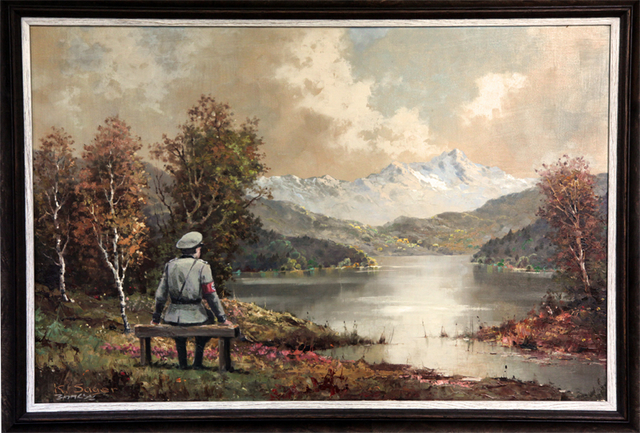
For Day 29 of his unsanctioned sojourn in New York, Banksy repurposed an original artwork, an overwrought pastoral oil painting purchased for $50 from a thrift store. With his painted addition of a solitary Nazi officer seated in contemplation on a bench, the scene of an autumn forest by a river with snowy mountains in the distance is transformed from kitsch Americana to Caspar David Friedrich-esque German Romanticism, the falling yellow leaves now signifying the decline of the Nazi regime as well as a warning, perhaps, of our own social and political decline.
Scrawling his signature under that of the original artist, Banksy, on his website (which existed only for the duration of the “residency”), entitled the work "The banality of the banality of evil, oil on oil on canvas, 2013," and described it as "a thrift store painting vandalized then re-donated to the thrift store," with the intention that the proceeds go to the Brooklyn-based nonprofit that benefits homeless people living with HIV/AIDS. Housing Works auctioned it off and ultimately, after much bidding drama, netted at least $450,000.

On the Village Voice
blog, writer Raillan
Brooks no doubt Googled “the banality of evil” to discover that it was
associated with Holocaust escapee and philosopher Hannah Arendt’s “theoretical reckoning of the Nazis'
rise to power.” Brooks, concluded, however, that it more likely had “something
to do with Banksy not really caring much about what he's actually saying”—when
it’s clearly the theme that underlies all his subversive enterprises.
A Report on the Banality of Evil is the subtitle of Arendt’s 1963 book, Eichmann in Jerusalem, an eyewitness account of the Nazi criminal
trial of Adolf Eichmann, who was accused of engineering the extermination of
European Jews. Writing originally in The
New Yorker,
Arendt expressed shock that Eichmann did not come across as a monster, but “terribly
and terrifyingly normal,” a man whose thinking was so conventional that he spoke
only in clichés. This led Arendt to develop her thesis that beyond Hitler’s vile nature, it was the mediocrity of
his functionaries, their unwillingness to think for themselves while attempting
to fulfill their mundane needs and individual ambitions—hence their
banality—that enabled the Nazi atrocities. Therefore
Banksy’s title has to do with the original painting being itself a cliché, the
work of a painter who is trying to please others rather than thinking for
himself, and by inserting the Nazi officer, Banksy is adding a symbol of
banality to banality, with his “oil on oil.”
While
being tried as a war criminal, Eichmann insisted on his innocence: he never
killed anyone or ordered that anyone be killed, nor did he have a grudge
against Jews. He was a man eager to get ahead and his job, which he fulfilled
efficiently, was to arrange for the transportation of Jewish prisoners to death
camps. To do otherwise, he explained on the stand, would be to break the law at
the time, and he was not a law-breaker. Their destination was not his
responsibility. Upon hearing his sentence of death, Eichmann said, “I am convinced in the depths of my heart that
I am being sentenced for the deeds of others.”


This
concept is at the heart of Bernhard Schlink’s 1995 novel, The Reader, later made into a film. One of two main
characters, Hanna, is being tried for war crime, but she’s not an officer,
nothing like it, simply a guard who never considers the possibility that she
could defy orders and unlock the burning church in which most of her prisoners
die. Like Eichmann, what’s chilling about Hanna is her ordinariness; she’s just
doing her job. Arendt suggests that evil is more accidental than intentional,
less a result of ideology and conviction than a by-product of petty ambition
and the drive for personal security.
Expanding
on Arendt’s thesis was Stanley Milgram’s famous psychological
experiment that measured the willingness of study participants
to obey an authority figure who instructed them to inflict what they thought were
electrical shocks on a hidden subject, an actor whose screams they could hear. Milgram
concluded that, “Ordinary people, simply doing their jobs, and without any
particular hostility on their part, can become agents in a terrible destructive
process.... (When) asked to carry out actions incompatible with fundamental
standards of morality, relatively few people have the resources needed to
resist authority.”
Commenting on
this experiment, Banksy has noted, “Garments are symbols of authority and we
have a powerful tendency to accept authority….Take the man out of the doctor's
costume and his test subjects refuse to do it.”
Ironically, while
railing against this failure of humans to question their environment, Banksy
consciously uses it to his own ends. Not one to skulk around in a hoodie, as he
appears in his 2011 film “Exit Through the Gift Shop,” one of his methods for avoiding detection is to look as official as
possible. To “turn invisible” he
recommends a high-vis vest, hardhat, clipboard, and business cards—not to speak
of three stories of scaffolding under a CCTV camera.

It is
therefore significant that Banksy’s Nazi officer is not depicted as an ogre,
but a lover of nature, which makes him all the more normal and therefore frightening.
In that context, Banksy’s entire crusade can be seen as one against what Arendt
called a “failure to think” or, in other words, mediocrity and banality in all
its forms.
The greatest crimes in the
world are not committed by people breaking the rules but by people following
the rules. It's people who follow orders that drop bombs and massacre villages.
As a precaution to ever committing major acts of evil it is our
solemn duty never to do what we're told, this is the only way we can be sure.
--Banksy, Wall and Piece.
Monday, June 16, 2014
Dirty Sugar: Kara Walker’s dubious alliance with Domino

Photo: Dennis Kardon © 2014
There’s much that disturbs me about Kara Walker’s much-lauded
and wildly popular installation
at Brooklyn’s defunct Domino Sugar refinery, but I’ll start with its undeniable
beauty. Made of sparkling white sugar, this gigantic, crouching sphinx-like figure,
with curves like a Brancusi,
looms like a symbol of purity in the vast darkness and decay of the factory’s
interior. The sweet smell is overwhelming, and the piece itself is intended to
degrade over time; when I was there, skeletal dark lines were beginning to form
between the polystyrene blocks that form the core of the sculpture.
Conceptually and figuratively, it’s a virtuoso performance that brilliantly
fulfills part of nonprofit Creative Time’s
original mission to ”support
the creation of innovative, site-specific, socially engaged works in the public
realm, especially in vacant spaces of historical and architectural interest…while
pushing artists beyond their normal boundaries.” [See note below]
So why
does its beauty upset me? Because the installations’ sheer gorgeousness and
spectacle serve as a distraction from the insidious agenda that makes a mockery
of another part of Creative Time’s mission, to “foster social progress.” I have long felt that Walker’s work—in which Black people are portrayed as passive victims of slavery engaged in psycho-sexual drama—doesn’t invalidate, but rather
reinforces the stereotypes whites have imposed on them to justify racism. In addition, it is entirely dependent on the gratuitous titillation that violence and sex
inevitably engender, regardless of the context—or the race of the person who
perpetrates them. Walker’s sphinx conflates two familiar white parodies of Black women: the big-assed, sexually available Jezebel, with her vulva hanging out for the taking,
and her opposite, the maternal, large-breasted but desexualized Mammy, who sublimates her own needs to fulfill those
of her white charges.
Vulgar
photos taken by visitors posing with the “sphinx” are all over Instagram, and castigated online by writers who are upset that the artwork is not being shown
proper respect. Derived from minstrel
shows where
whites in blackface lampooned Black people, the Jim Crow caricatures Walker appropriates were
created with the specific intention of provoking ridicule. Should we then be
surprised when they succeed?
Roberta
Smith in the Times writes that Walker “evokes the history of the
sugar trade, its dependence on slavery and slavery’s particular degradation of
women, while also illuminating the plagues of obesity and diabetes that keep so
many American dreams unfulfilled.” Yet it can also be said that Walker is
providing massive advertising for Domino Sugar,
which donated the 80 tons that make up the sculpture. As a sponsor, the
familiar Domino logo is prominently featured on a wall at the site as well as
Creative Time’s website,
and a Google search for ‘“Kara Walker” Domino’ garners over 88,000 links. Statements
that speak of “history,” along with the fact that Walker’s images are based nostalgically
on our antebellum past, present a view of slavery that locates it dangerously
outside the present capitalist global economy—when it is still very much part
of it.
While Creative Time’s website includes a compelling
essay written by the narrator of a documentary
about the forced and child labor that constitute modern slavery, it doesn’t
name the mega-corporation that owns Central Romano, the plantation on which it was filmed: Flo-Sun,
of which Domino is its best-known subsidiary. If the people at Creative Time,
along with Walker, have seen this film—as indeed they must have in their
research—I wonder how they feel about the ironic possibility that Walker’s
sculpture might have been enabled by slave labor.
Pepe
and Alfy Fanjul, who run Flo-Sun, inherited the sugar empire from their
Cuban father. Dubbed
“the Koch brothers of Southern Florida,” they‘re said to be friends and
neighbors of the Kochs
who, in comparison with the sugar barons, look like Mother Theresa clones.
In the Dominican Republic, the
Fanjuls have been subject to repeated allegations of labor exploitation,
particularly of undocumented Haitian migrant workers with little to no legal
standing before Dominican government institutions. The U.S. Department of
Labor includes sugar from the Dominican Republic—much of which comes from
Fanjul-owned plantations or is imported to Fanjul-owned refineries—on its
annual "List of Goods Produced by Child or Forced Labor."
Both a 2005 Canadian Broadcasting
Company documentary [“The Price of
Sugar,” narrated by Paul Newman, view here]
and the 2007 film "The Sugar
Babies," narrated
by Haitian writer Edwidge Danticat [author of the Creative Time essay] call attention to the working
conditions of impoverished cane-cutters laboring at the Fanjuls' Central Romana.
In the United States, meanwhile, opponents of U.S. agricultural
subsidies and government protections have long
criticized the Fanjuls for building their dominance in the domestic market on
the backs of artificially inflated prices and the U.S. taxpayer…. more
Essential
reading includes the 2001 Vanity
Fair article, “In the Kingdom of Big Sugar,” which inspired the
two documentaries, a CNN piece on how the Fanjuls
could be the “First Family of Corporate Welfare,” and this on their strong-arm
tactics with lawmakers, from Wikileaks.
You
could spend days, as I did, reading about the moral and ethical transgressions of
the Fanjuls, and just when you think it couldn’t get worse, it does: In 2010,
the Post’s Page
Six reported
that Pepe Fanjul’s executive assistant of 35 years is the ex-wife of former KKK
leader David Duke, and the current wife of Don Black, a former KKK grand wizard and member of the American
Nazi Party. He now runs white-supremacist website StormFront.org. A company representative
said, “While we may not agree with someone’s politics, we wouldn’t terminate
them for that….We will not discriminate against anybody….”
One
could also make an issue of the extensive advertising Walker is providing for
another sponsor, Two Trees Management, owned by Creative
Time board member Jed Walentas, who worked for Trump before taking over
his father’s real estate business, and will have 1700 luxury apartments to sell
in his massive waterfront development on the site (as well as 700 affordable
units, the number bumped up under pressure from Mayor de Blasio). And then
there’s the non-renewable polystyrene that went into this gigantic
temporary work that, like Styrofoam, could take a million years to break down. However
next to the question of how the 80 tons of Fanjul sugar were most likely sourced,
these are mere quibbles.
So
much for institutionalized protest—to paraphrase Banksy, this is art packaged to look like
radicalism while supporting capitalism at its worst.

Photo: Carol Diehl (2014)
***
Note: I lifted this
mission statement from Creative
Time’s Wikipedia entry, well aware that it is not same statement that appears on
their website. However having been Director of Public Relations (a somewhat
hilarious title, given that I was the entire department) for Creative Time in
the mid-80’s, when it was a pioneering organization and very true to its
nonprofit status, these were the words used to promote it and I feel best
represents the inspired vision of founder Anita
Contini.
Related reading: The Flying Walentases (on the developers in NY Mag), Marina Budhos's Kara Walker and the Real Sugar Links, Nicholas Powers, Why I Yelled at the Kara Walker Exhibit and the anthololgy, Kara Walker No/Kara Walker Yes/Kara Walker?
Related reading: The Flying Walentases (on the developers in NY Mag), Marina Budhos's Kara Walker and the Real Sugar Links, Nicholas Powers, Why I Yelled at the Kara Walker Exhibit and the anthololgy, Kara Walker No/Kara Walker Yes/Kara Walker?
Sunday, January 5, 2014
Winter Hiatus
Just a note to say that I haven’t abandoned blogging, just
taking a break after seven years and over 500 posts--and saving myself for drawing
and a bigger project, yet to be unveiled, that’s taking up all of my brain
cells. Right now I’m happily ensconced in Los Angeles, soaking up the sun, doing
kundalini yoga every day, and thriving in the relaxed atmosphere. I'll work
on trying to miss New York, because I’ll be back soon enough.
Happy New Year!

Carol Diehl, 2013, ink and pencil on Bristol, 11 x 14.
Sunday, November 3, 2013
I ♥ the Guggenheim
If anything, by completely obscuring Frank Lloyd Wright’s
architecture with his installation,
James Turrell reaffirmed my already
profound love for the Guggenheim
–like the new appreciation one might have for a healed limb after the cast has
been removed.
At the museum Friday for the Christopher
Wool exhibition, I was reminded of how Wright created not just a place for
art, but for people—a social space in one big room that hums like a party. In
most museums the other visitors are annoyances, always in the way, going the wrong
direction, talking too loudly or blocking the view—but at the Guggenheim
they’re fellow travellers. The ramp is like a sidewalk where you can stop and
chat (no need to whisper); it respects your pace. You can see what’s ahead above
or across the atrium and get exited about it in advance, stand as close or look
as far as you want. What other museum offers a view from over 100 feet?
Plus the natural light that comes in from the skylight at
the top….
In the usual rectangular museum gallery, I’m overly
conscious of the amount of time I’m spending in front of something, and am
always torn – should I be looking at this or this or is there something more
interesting behind me? What am I missing? And this time at the Guggenheim, when
I exited the ramp to see the paintings installed in the one conventional room,
they lost some of their dynamism. I didn’t want to be there, enclosed, with no
windows. I wanted to be “outside.”
I not only remember the work in exhibitions I’ve seen at the
Guggenheim, I remember where it was situated and how it felt to come upon it—the
“uninterrupted, beautiful
symphony” of architecture and art Wright intended.
Further, there’s a single toilet or two at every level, so
no need to descend to a dungeon and crowd into the usual bathroom
horribleness—how civilized is that?
Our forebears made art on the walls of caves with no right
angles. I think they had had the right idea.

Subscribe to:
Posts (Atom)

