Monday, January 22, 2018

Adventures with the Berkshire Museum


Photo: iBerkshires.com


Who would have thought that our little Berkshire Museum in Pittsfield, MA, near where I live in southwestern Massachusetts, could cause an international ruckus. It has, however, in its attempt to divest its collection of 40 of its most valued and beloved artworks to fund the gutting of its elegant Gilded Age building and the installation of a children's science museum. You can read more about it in Felix Salmon's New Yorker piece, and Charles Desmarais' recent article in the San Francisco Chronicle. As followers of my Facebook page know, I've been working with the citizen's group, Save the Art--Save the Museum, in the hopes that we can bring the art back and restore the Museum's original focus on the art and natural history of the region. Below is my op-ed for the February issue of Berkshire Trade & Commerce:

Saving the Berkshire Museum

By now even people in San Francisco, where it was on the front page of the Chronicle a few weeks ago, know about our Berkshire Museum’s plans to sell the best of their art collection and raise $60-80M to fund a new mission. The National Review called it “the biggest art-world story of 2017,” and indeed, it has been written about in over 4,000 outlets worldwide.

The controversy has attracted attention and sparked widespread opposition because it’s about much more than the specific artworks the Museum's board and staff intend to permanently send away from Pittsfield. Once transferred into private hands, it is most likely that these important works, at least in our lifetimes, will never be seen in public again. The action sets a dangerous precedent for all museums, libraries, and historical societies, and is a blow to the very idea of public access to original artworks, historical artifacts, and manuscripts.

Such deaccessions are related to the damaging long-term national trend toward the privatization of many kinds of assets previously held in the public trust. Escalated under the Trump administration, this includes the selling off of national parklands for private mining and drilling, such as is occurring in the Berkshires’ own Otis State Forest and the plan for PCB dumps in the Housatonic River, as well as the concern over “net neutrality” and control of the Internet which is, in essence, a vital public utility. Responsibility for fixing the infrastructure and the running of prisons, hospitals, and schools, is being transferred to private operators motivated by profit rather than public service.

In contrast, institutions such as the Berkshire Museum were specifically created to provide resources and services for the benefit of the community, with the boards considered the stewards and protectors of the assets. Called “trustees” for a reason, they have heretofore been guided by ethical constraints that only allowed sales from collections for the purpose of improving the collections, not to fund operational expenses. Similarly, those who donated items did so with the intention that they would be cared for and available to the public. The ethical guidelines also have another function, which is to ensure that boards will not leap to sell from collections instead of doing the harder work of fund-raising, or use such profit for individual gain, as in the awarding of construction and other operational contracts to special interests, or the raising of administrative salaries. 

Because tax-exempt organizations are beholden to the public whose taxes contribute to their support, their first priority should be the nurturing of community trust. Toward this end, it is essential that their operations and financial records be fully public and transparent, with any significant changes in mission made in the context of community engagement. In the case of the Berkshire Museum, however, many felt betrayed by the Museum leadership’s decision to sell the art, as well as the way they went about it. The Museum’s much touted (and no doubt expensive) “two-year planning process” lacked transparency, rendering its results invalid, as at no time were participants informed that the “New Vision” would be achieved through the sale of important and much-beloved artworks. Instead it was a fait accompli, announced after the deal with Sotheby’s had been signed and the art already removed from Pittsfield. Further engendering suspicion, the Museum held back the full list of the 40 works until public uproar forced their revelation.
In addition, although the Museum has asserted that if it does not sell the artworks it will be forced to close in eight years, officials there have offered no detailed proof to verify this claim. Meanwhile, ongoing analysis by several independent experts has questioned this premise, as well as the need for a $40M endowment, considered wildly inflated for an institution of its size. Note that the Norman Rockwell Museum gets by with an endowment of $4.5M, while the Hudson River Museum in Yonkers, NY, with a similar size, mission and demographic as the Berkshire Museum, has an even smaller endowment. The Albany Institute of History and Art, in an equally economically challenged area, mounts exhibitions reviewed in the New York Times on an annual budget of $500,000 less than the Berkshire Museum, and employs two curators, where the Berkshire Museum has none.

So, yes, the Museum’s actions have created a crisis, but within that crisis lies new opportunity. A recent letter to the Berkshire Eagle quoted P.T. Barnum saying "Do not squander good or bad publicity but exploit it!" The writer suggests that, inspired by Barnum, a “Forty Works Exhibition” could be one of the biggest art events on the East Coast for 2018. In addition, fund-raising opportunities have increased a hundredfold, in just the kind of circumstances that enabled the Detroit Institute of the Arts to reestablish itself after the City of Detroit threatened to sell off its holdings to fund the sagging city economy.

Although we’ve been divided, what we have in common is that we love the Museum. The citizens’ group of which I’m a part, Save the Art—Save the Museum, has repeatedly invited the trustees to use the passion ignited in the community, harness the energy of all who want the Museum to survive, and come up with a revised plan that saves the cultural treasures of the Berkshires while creating financial stability.
To mobilize this outpouring of local and national care, the Museum's leadership must courageously acknowledge the public outcry against their plans and agree to work constructively with the voices that have emerged, particularly those art and museum professionals who have offered help.

In our interconnected world, only collaboration will bring about goodwill and the long-term enthusiastic support the Museum will need for whatever mission it adopts. Yes, the Berkshire Museum can be saved, but only by bringing back the art and engaging in genuine community dialogue.

Tuesday, March 28, 2017


Dana Schutz's painting in the Whitney Museum Biennial, is based on a 1955 photo of 14-year-old Emmett Till's mutilated body, published in Jet Magazine and credited with inspiring support for the civil rights movement. Till, an African-American from Chicago, was killed in Mississippi by two white men who were acquitted, although later admitted to the crime. In 2008, at age 82, the woman who had accused him of making advances recanted her story.

-->
What the current art world controversy around Dana Schutz’s painting of Emmett Till tells me, is that a preponderance of white artists, who think of themselves as liberal, have no awareness of their (overused term alert!) privilege and unconscious racism. Exclaiming in droves on Facebook and elsewhere that they know better how black people should respond, their righteous arrogance is mind-boggling—perhaps not a surprise to blacks, but to me, because these are people I know.  

This also happened a couple of years ago when issues about Kara Walker came up on my blog, with comments on Facebook. Walker, a black artist whose work is collected primarily by whites, often features blacks being abused by whites, as well as Jim Crow imagery, which many blacks find degrading. But when black artists and academics expressed this on my FB page, white artists had no qualms about telling them they were “ignorant” and “anti-art.” One even said that Michele Wallace, who had written a negative essay about Walker, “didn’t understand art”— obviously unaware that Wallace is the daughter of venerable black artist Faith Ringgold.

Now the black activists protesting the Schutz painting are being called “poseurs” and “panic merchants,” “a niche group” whose responses are “ridiculous” “nit-wit shit,” and “about some people assuming they have the exclusive right to certain aspects of American history.”

The most frequent cry from whites is that of “censorship”— a term I associate with attempts of authoritarian governments to control the masses, rather than the struggle of the downtrodden to keep their experience from being co-opted and mischaracterized by their oppressors.  One art editor on FB called it a “whiff of the Cultural Revolution,” while a socialist columnist, addressing the “foul attempt to censor and suppress” the painting, wrote, “The arguments being used are worthy of the Nazi officials who banned Jewish artists from playing or conducting classical music on the grounds of their ‘un-German’ spirit” – to which a commenter replied, “Bringing up Nazis in this issue is like a Nazi painting a picture of the camps and blaming the Jews for being too sensitive.”

I think of a friend who once worked in a dentist’s office that was decorated with pastoral prints. One showed a group of good ol' boys sitting under a tree, and hanging from one of the branches, barely perceptible, was a noose. The white patients who crowded the office never noticed it, nor did the white dentist who chose it, but it gave my black friend chills. At her request, the dentist took it down. Censorship? Political correctness? No, simply consideration for his employee. And a reminder that not only may we not see things as others do, we might not see them at all.

I once asked a white collector why he bought a Kara Walker work on paper. “I liked the way it was drawn,” he said. And the imagery? “Oh, I didn’t care about that.”  

Another white artist friend calls the controversy “trivial” because, he says, it has nothing to do with the day-to-day struggle of poor blacks. In fact, a number of white artists were maintaining that art is unimportant in the scheme of life, or in the face of our current political miasma—a curious stance for those who have devoted their lives to it. But when the protestors call for the destruction of the painting, they turn around and argue for its intrinsic value as if it were a sacred object.

While it’s true that many economically disadvantaged blacks, survival on their minds, may never know about this issue and, if they did, might not care what happens at the Whitney, the arts are important in shaping the culture and the perceptions of those who make decisions about our lives. Do we hold our judgment and listen? Or continue to send the message that the white establishment couldn't care less?

Beyond the question of the subject matter, a big problem with Open Casket, as Aruna D’Souza and Ann Landi have also pointed out, is that it’s not a great painting, and one wonders if the result would have been different if it were. Instead Open Casket is a Dana Schutz before anything else, with the result that it trivializes and makes a decorative cartoon of a horrific event. As one commenter said, “I'm not sure that 'rubber stamping' a style on a loaded subject is a good strategy for a successful painting”.

Adding insult to injury is Schutz’s statement that she was empathizing as a mother, if not a black mother, which indicates she must have missed the conversation around the distinction between “Black Lives Matter” and “All Lives Matter,” at the top of the news the last several years.

If I were King of the Whitney, I’d leave the painting up and make the dialogue around it part of the exhibition, posting the dissenting remarks and holding symposia with an eye to giving black voices a platform—because, in the end, the conversation is much more consequential than the painting.


Friday, March 10, 2017

Hello, back again, for Banksy....

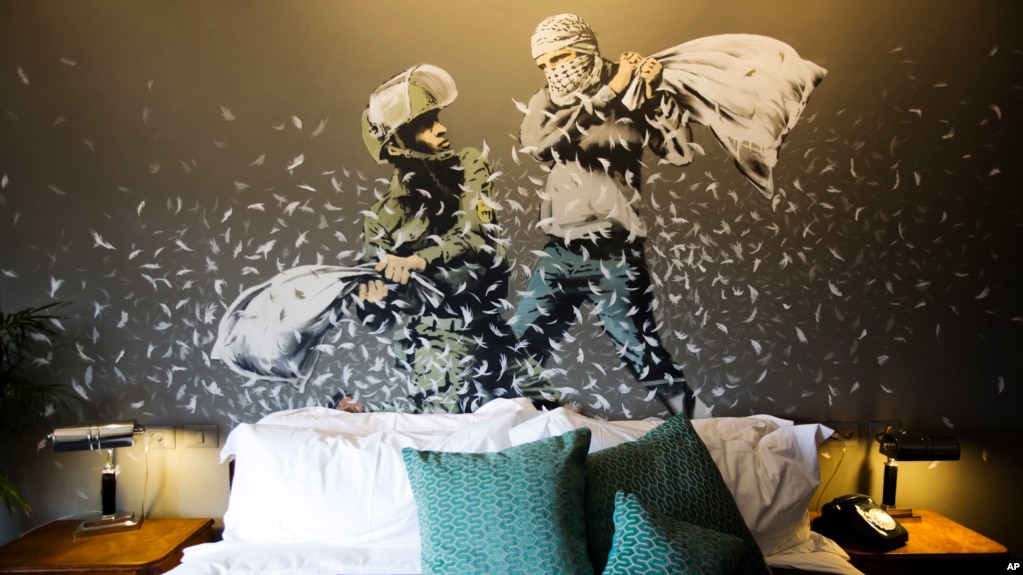
At 6:30 last Friday morning I was waiting for the BBC to contact me with details about Banksy’s latest project – a hotel in Bethlehem, named the “Walled-Off,” facing the West Bank barrier wall, with "the worst view in the world." The day before I’d received an email with the heading “BBC NEWS-URGENT” (which, like most messages that say URGENT nearly went into the spam folder) and had agreed to comment on it live at 9:30 in their studio at 200 Liberty Street. When I got there (found a taxi, whew!), finally passed Pentagon-like security and arrived on the 18th floor, I was greeted by a beautiful woman named Kizzy. She took my coat, gave me a plastic cup of water, and immediately ushered me into the sound room—a padded cell with a wall-size green screen and projected view of Manhattan. In front of the screen was a desk and chair, with an eerie camera lens embedded in the opposite black wall. To the right was a big monitor with me, only me, on it (if you think looking into a magnified mirror is scary, try HD!). Kizzy wired me up and left, closing the door. I fluffed my hair in the monitor. In my ear I could hear an announcer, parts of the news program, and a lot of interference. A British male voice came on, asked me to say something to test the volume, and told me we’d be live in seven minutes. I still had only the barest information about Banksy’s project and no idea what I’d be asked.


I did fine. Interspersed with my comments were those of a male British critic with a sonorous voice, clearly an experienced presenter (I never caught his name), who did even better. Kizzy came in, unwired me, gave me my coat and I went out into the sunshine, off to tea in Tribeca with my friend, Elenor.


More images here:

Tuesday, June 28, 2016

Bill Cunningham and me

In 1993, on one of the most horrid hot humid days ever in New York, I was on Fifth Avenue with my Chinese paper parasol when a man with a camera ran up and snapped it in my face. I said, nastily, “You can’t do that” and he said, just as nastily, “I wasn’t taking a picture of you, I was taking a picture of Tiffany’s window behind you.” I walked about two more blocks before realizing that he was Bill Cunningham from the Times and when I got home, wrote him a short apology, saying that I mistook him for a rude tourist from Iowa. I forgot about it completely until several Sundays later when I was meeting a friend who had with her a copy of the Times—and there I was, in a layout about parasols, snarling under mine. That week I received a print of the picture in the mail and a note from Cunningham who wrote, “The image of you and your parasol turned me into an aggressive New Yorker…apologies. The tourists are the polite ones…it’s me who is not too polite. Best regards, Bill C.” – more gracious than I deserved.


Saturday, October 3, 2015

Bristol Graffiti Tour

One of the things I appreciate about nature is that there’s no advertising. Even more, except for trail markings, some artfully piled rocks, the rare piece of litter and the flag at the top of the mountain, when I hike in the woods I don’t have to come in contact with anyone else’s sensibilities.

Then there’s New York, which is nothing but other people’s sensibilities, all vying for my attention. The idea that advertisers get to shape the human environment is one of the worst outcomes of unfettered capitalism. Do I really want to think about psoriasis when I’m on the subway? Or look at that guy in his Calvins high about Houston Street? We can’t avoid it, advertising is everywhere, on every possible bit of real estate including the risers on station steps, and we accept it with no complaints—but when someone presumes to write his/her name on a wall with a marker, everyone goes apeshit.

Art or not, at least it’s the sign of a real person, someone who’s not trying to sell me anything, just letting me know s/he was there.


So what would the world look like if the graffiti artists were to prevail? It would look like Bristol, England, which I visited on my trip to Banksy’s Dismaland (more about that in a later post):


Banksy's "Mild Mild West" next to The Canteen, which advertises itself as "responsible, delicious, and noisy", and where we had roasted duck salad with celeriac root fries. Those street artists eat well!


Work by friend, PETRO, who was our guide.


And I love these little whimsical bits you could easily miss. Later we went to the opening at Fluorescent Smogg Gallery to celebrate more work by PETRO and others:


COSMOGG SECRET INSTALL - BRISTOL 17th September from Fluorescent Smogg on Vimeo.


All photographs by Carol Diehl © 2015


Monday, September 28, 2015

Banksy and the Problem of Writing about Humor You Don’t Get (Dan Brooks in the NY Times, Part II)


In a previous post I called out (and, I hope, shamed) Dan Brooks in his NY Times essay, “Banksy and the Problem with Sarcastic Art” for writing a negative critique of Banksy’s pop-up theme park, Dismaland, without bothering to actually experience it. Now I’d like to address another aspect of that piece, the fact that Brooks doesn’t get British humor, thereby offending an entire culture.

Before expounding, Brooks might have, like any good writer, consulted Wikipedia, where it says: “A strong theme of sarcasm and self-deprecation, often with deadpan delivery, runs throughout British humour.” This is a surprise? I thought humor was one of Britain’s most famous exports. But then Brooks lives in Montana.

So, of course, the Brits say it best, as evidenced by these comments on Brooks’s blog:

Patricia:  Hello your piece about Dismaland was a load of bollocks just saying .smiley face


Sam: Hey arsehole, I noticed you didn’t offer a right to reply on your hilarious Banksy critique you coward. American critics can’t seem to help but embarrass them selves when it comes to understanding British cultural work. The reason you can’t pin down where the depth lies in his work is because you can only see it through the lens of your own cultural experience you prick. Its not for you, (American goal/success obsessed, materialists), its for us, (British people who live under the yolk of class oppression). He’s made it clear he doesn’t want to be in the work and that’s a big part of its value. Just accept it. It’s Far more poignant and rare to see outward looking work like his, rather than most American introspective conceptual art that’s obsessed with the artist and the individual, that when you get down to it, exists as little more than in invitation to fuck or be fucked. Write about shit you see in your own culture but leave our work out of it.

           
Beaver:

 LOL. Takin’ some heat for your Dismaland piece. I guess that’ll happen when you deconstruct the only functioning tool in the room. And anyway, if you can thrill to the demagoguery, than surely you can at least find some amusement in the irony of a society which makes a bond of the chasm and defends it by hurling at you fragments of their smashed and deconsecrated urn, the last remaining ashes of wit mixing irretrievably in the wind with whatever comes next.


Dismaland, featuring "Mediocre" by Axel Void of Miami. Photo: Carol Diehl © 2015