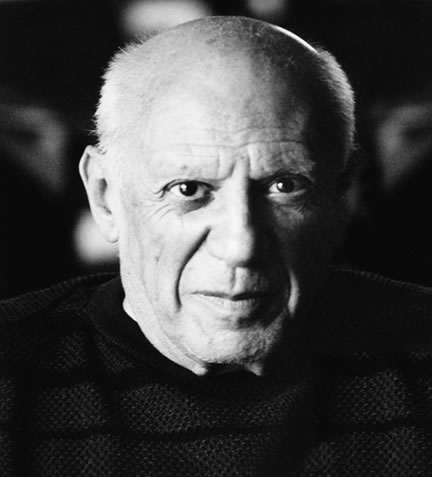
In a comment on my previous post, I was asked why I bothered with what Mario Naves thought and I’m betting that anonymous commentator was a guy. Because women understand that as one woman is portrayed, we all are. Naves’s comment about Nevelson not smiling for her portrait still bugs me. It makes me think of all the times I've walked down the street and been ordered by some jerk to smile. And then there was the guy, just the other day, who shouted out that I was wearing “the wrong clothes” because I was wearing black on a warm day. Meanwhile he had his shirt off with his belly hanging out over his shorts.
One of my lessons came from “the other Louise”—Louise Bourgeois (people actually called them that—can you imagine Richard Artschwager and Richard Tuttle being known as “the two Richards”?) who I was working with on a story for Art & Antiques just as they were changing owners and editors. While doing the Bourgeois article, another piece I’d written about my artist great-grandmother, Daisy Challiss Faust, was about to be published. A critic friend warned me early on in my writing career to be careful about the contributor’s credits that appear in the front of magazines, that they’re often handed off to just anyone who may not know what they’re doing. So I insisted on vetting the credit and when I called in, the intern (a woman, by the way) who’d written it read it to me, down to the last two sentences which went: “Diehl has recently gotten a grant to do some painting of her own. Will it be in the style of her great-grandmother?”
I thought wow, here it is 1994 and I’m still fighting the same belittling attitudes my great-grandmother faced nearly a century ago. I had to have a rather big fit to get the credit pulled from the magazine but I prevailed. That night, when I saw Louise at a dinner, I told her the story and added how grateful I was for the role model she provided in standing up for herself. “It’s not about promoting our art but defending it,” she said, pounding her fist on the table, “We must defend our art!”
Sunday, August 26, 2007


Tuesday, August 21, 2007
Nevelson and Naves
I finished writing my Louise Nevelson article and it’s as if I’ve just recovered from a disease, although not necessarily an unpleasant one. When I write about artists in depth I read and think about them so intensely that they become part of my life, part of me. Especially if I’ve done an interview and then listen to the tapes, after which their voices drone on in my head. Robert Irwin was once stuck there for a year, and it was pretty hard to take. This time, with Louise, I felt as if she entered my DNA—but then she would; we all know she wasn’t shy. Also there was, I discovered, a strange synchronicity to the chronology of our lives: we have the same birthday, we both married at 19 and led lives as suburban housewives for 11 years until separating from our husbands, and started the serious study of art late, at the age of 30.
Perhaps because I now identify with Nevelson—but more so because I’ve gained so much artistically from knowledge of her work—I was annoyed when, in my research, I read Mario Naves’s review (The New York Observer, May 14th) of the her Jewish Museum retrospective (on view until September 16th) which begins:
Upon opening the catalog for The Sculpture of Louise Nevelson: Constructing a Legend....you're immediately confronted with a photo of the artist in early middle age, her features retouched to emphasize the lines in her face.

This is quite a stretch to make a case for image-building. When I contacted the museum, I learned the photograph was retouched, but by whom and for what reason is not known, and whether or not it emphasizes the lines in Nevelson’s face is a matter of opinion. It’s possible, they say, that the retouching could have been done to add shadow and contrast to areas that were washed out by the lighting. There’s no date on the photo, but in it Nevelson appears to be in her middle-forties and the style of make-up would also indicate that it was taken in the 1940s, at least twenty years before she became a public figure. Naves says:
She looks to the viewer unsmiling and with unflinching self-possession.
Oooh self-possession! Bad. Do we complain or even comment that Picasso was self-possessed and didn't make cute for the camera? And that Mondrian! Always so fucking serious!
Naves goes on:
More portraits follow in chronological order, bearing witness to Nevelson’s transformation from working artist, dressed in a white wool sweater and cap, to a creature with (to put it mildly) a distinct sense of fashion. In the last photograph, Robert Mapplethorpe’s portrait of the 87-year-old Nevelson, she’s as haughty and garish as Norma Desmond in Sunset Boulevard.
Naves makes it seem as if Nevelson was unwittingly making herself ridiculous, where if you compare the film still of Norma Desmond here with the Mapplethorpe here, it seems more likely that the similarlity was intended, and that Mapplethorpe and Nevelson were having fun riffing on a classic image.
Naves backtracks just a bit by saying:
Unlike Gloria Swanson’s faded-movie queen character, Nevelson (1899-1988) was very much self-aware. She knew that cultivating an image, however contrived or flamboyant, would earn her recognition. Her regal bearing, bandanas, dramatic gestures and spidery false eyelashes created an identifiable persona: the Pharonic Grande Dame of Sculpture. Nevelson was, in her own way, as P.R.-savvy as Salvador Dali or Liberace.
Perhaps because I now identify with Nevelson—but more so because I’ve gained so much artistically from knowledge of her work—I was annoyed when, in my research, I read Mario Naves’s review (The New York Observer, May 14th) of the her Jewish Museum retrospective (on view until September 16th) which begins:
Upon opening the catalog for The Sculpture of Louise Nevelson: Constructing a Legend....you're immediately confronted with a photo of the artist in early middle age, her features retouched to emphasize the lines in her face.
This is quite a stretch to make a case for image-building. When I contacted the museum, I learned the photograph was retouched, but by whom and for what reason is not known, and whether or not it emphasizes the lines in Nevelson’s face is a matter of opinion. It’s possible, they say, that the retouching could have been done to add shadow and contrast to areas that were washed out by the lighting. There’s no date on the photo, but in it Nevelson appears to be in her middle-forties and the style of make-up would also indicate that it was taken in the 1940s, at least twenty years before she became a public figure. Naves says:
She looks to the viewer unsmiling and with unflinching self-possession.
Oooh self-possession! Bad. Do we complain or even comment that Picasso was self-possessed and didn't make cute for the camera? And that Mondrian! Always so fucking serious!
Naves goes on:
More portraits follow in chronological order, bearing witness to Nevelson’s transformation from working artist, dressed in a white wool sweater and cap, to a creature with (to put it mildly) a distinct sense of fashion. In the last photograph, Robert Mapplethorpe’s portrait of the 87-year-old Nevelson, she’s as haughty and garish as Norma Desmond in Sunset Boulevard.
Naves makes it seem as if Nevelson was unwittingly making herself ridiculous, where if you compare the film still of Norma Desmond here with the Mapplethorpe here, it seems more likely that the similarlity was intended, and that Mapplethorpe and Nevelson were having fun riffing on a classic image.
Naves backtracks just a bit by saying:
Unlike Gloria Swanson’s faded-movie queen character, Nevelson (1899-1988) was very much self-aware. She knew that cultivating an image, however contrived or flamboyant, would earn her recognition. Her regal bearing, bandanas, dramatic gestures and spidery false eyelashes created an identifiable persona: the Pharonic Grande Dame of Sculpture. Nevelson was, in her own way, as P.R.-savvy as Salvador Dali or Liberace.
So being "very much self-aware" is all that separates Nevelson from Norma Desmond? How about that Norma Desmond was pathetic, desperate and needy, a woman who gave a party to which no one came, while Nevelson was celebrated, in her power? Everyone wanted to be at her party. At the time of the Mapplethorpe photo, Nevelson was the epitome of a satisfied, fully-realized woman. And garish? Whatever degree of garish she was, it landed her on the Best-Dressed List. And then the times, the seventies and eighties, were pretty garish all around. I wonder what Mario Naves was wearing back then, when he was in his teens and twenties. Button-downs and Oxfords? It was an era when people, especially artists, used style to express themselves, unlike today when art is big business and everyone’s cowed into Prada.
Okay, on to the idea that Nevelson’s look was a P.R. ploy. If it was such a great scheme, then how come it took so long—like 20 to 30 years—to take effect? Those who have done their homework, who’ve read Laurie Lisle’s wonderful biography Louise Nevelson: A Passionate Life know that Nevelson’s style was with her from the beginning, a source of discomfort for her husband in her pre-art years. Lisle writes: “While Charles dressed conservatively, Louise liked to create flamboyant outfits for herself, like a dress decorated with a dickie made from a wedding napkin. He often insisted she return purchased outfits that he disliked, and he began to be embarrassed to walk down the street with her.”
Imagined conversation:
Charles: Oh my God, Louise, are you going to go out looking like that?
Louise: Don’t worry, Chuckie, I know what I’m doing. When I leave you I’m going to study art, and in 50 years I’ll be famous and this is the look that’s going to put me over.
Anyway, what’s wrong with wanting attention and going about it in an artful way? Nevelson was never anything but elegant. And being a tall, dark woman with excellent bearing and an acute awareness of her body allowed her to pull almost anything off. The day I went to interview her, a few months before she died at 89, she was wearing an impeccable man-tailored suit of crisp blue ikot fabric (a Japanese-ish cotten with a thread-dyed geometric pattern), what looked like men’s black patent leather wing-tip lace-up shoes, and a fabulous fur coat. Then and there I decided that older women who go the fluffy, ultra-feminine route look like men in drag, and that when I’m eighty I’m going to have men’s suits made for me, just like Louise.
But back to Naves:
The girded accumulations of individual components are artful rather than lively. Overall, they’re rather boring. Butting a dozen or so boxes up against or on top of each other results not in great complexity, but homogeneity.
The artist, Willie Cole, seen in a video at the end of the exhibition, speaks of Nevelson’s art in terms of “embalming.” Inadvertently, but with devastating precision, Mr. Cole hits the black and rusty nail on the head. Nevelson’s pieces aren’t memento mort, they’re just dead.
Their handsomeness is derived from their inertia. Nowhere is this clearer than Mrs. N’s Palace (1964-77), a shack-like enclosure that’s less Temple of Dendur than house of horrors. Nevelson’s gift for juxtaposition is undone by her theatricality. Here she replaces stoic spectacle with outright hokum. It’s funereal bombast with mood lighting—a sad and all-but-laughable achievement.
Not for nothing is Nevelson hailed as a progenitor of a numb-to-its core movement like minimalism, or the didactic excesses of most installation art. Nevelson’s sculpture ultimately privileges the artist’s prerogatives over art’s vitality. We’re left with monuments of personality rather than homages to life. The latter can be picked out here and there, and to impressive effect. Don’t fool yourself, though. Nevelson the Legend wins out over Nevelson the Artist. It’s a disheartening denouement.
I agree with Naves about Mrs. N’s Palace, although I find the use of the word “shack,” which implies something crude, in disrepair, or hastily thrown-together, inappropriate. I try not, however, to evaluate artists on the basis of their least successful work (instead of the "homages to life...that can be picked out here and there, and to impressive effect") and wonder why he didn’t mention the other room-size piece, Dawn’s Wedding Feast, which happens to be white. And there’s a contradiction here—Naves admits Nevelson is “hailed as a progenitor” yet insists she made her reputation on the basis of her persona.
Note to women artists: Don’t be too minimal; don’t be too theatrical. Don't let too much personality show in your work. Make sure that you smile a lot, act conservatively, dress conservatively, and, above all, don’t be old. I guess Nevelson should have gotten Scaasi, her favorite couturier, to design her a burka.
Thursday, August 16, 2007
Antony & Cleopatra, continued
Over our pre-Shakespeare dinner the other night, Scott entertained Roberto and me with stories of his parents' fickle marriage habits and has tied it all together by sending me this photo of his father and Wife #2 (of four), as Antony and Cleopatra, somewhere in Manhattan in the mid-70s.

Antony & Cleopatra
Last night was the perfect summer evening, stars and crickets in full force. It began with tender rack-of-lamb in Scott’s magical gazebo, and continued through a really silly production of Antony and Cleopatra at Shakespeare & Company, mostly made so by legendary Artistic Director Tina Packer’s gross miscasting of herself as the heroine. It wasn’t just Packer’s age—Shakespeare’s Cleopatra was at the end of her life, and in those days you were a Senior Citizen at forty—but moon-faced, pug-nosed, overblown, and wearing costumes that looked as if they were leftover from A Midsummer Night’s Dream, she was hardly the Egyptian seductress who, in Plutarch 's account, once had herself delivered to Caesar’s bedroom rolled into a rug. Instead it was like watching Marc Antony make love to Puck’s grandmother. Then there were the tie-died soldiers’ uniforms (isn’t this a contradiction in terms?) and the really cheesy, very prickly-looking, gold metal wreath that Octavius Caesar (superbly played by Craig Baldwin) had to wear on his bald head. No wonder he kept taking it off. And did I mention the anachronistic sound of Velcro as battle garments were being removed? But the wonderful thing is that, despite all this ridiculousness, Shakespeare prevailed, and I was delighted just to sit there and absorb each perfectly-turned phrase as it washed over me. And while the love part was kept from ringing true, the futility of power struggles and the stupidity of war came through in full force, along with a poignant lesson in the fragility of human life. It makes me wonder, haven’t we learned anything since then? But then I remember how Shakespeare had to pass rows of severed heads on spikes on the London Bridge as he went to work every day, and I conclude that maybe we have learned something. Just not enough.
You can read two completely opposite reviews of this production in The Boston Globe and Variety.
You can read two completely opposite reviews of this production in The Boston Globe and Variety.
Sunday, August 12, 2007
Frank & me
A month or so ago I was painting in the manner of Gerhard Richter. Now I find myself laboriously drawing a Frank Stella as the basis for a painting. I’m surprised at this recent tendency of mine, because I’ve always loathed art about art, thinking it was way too art world-y self-referential in the most pretentious way (as if being art world-y self-referential could be anything but pretentious). Besides, if you’re an artist and your work is better than the artist you’re referencing you’re dragging yourself down, and if that artist’s work is better than yours (think David Salle aping Chardin) the result will be an unfavorable comparison. Also I’m always ranting about wanting to see original—as in “not borrowed”—imagery in art. Nevertheless, I’m having fun—I think of it as collaborating with Frank—although I’m sure it’s taking me much longer to do this drawing than it did for Stella to make the sculpture. And I suppose if Stella can base a part of his oeuvre on a dog toy (see Does Frank Stella have a dog? May), I can base a painting on a Stella that’s based on a dog toy. We’re getting very derivative here.
Friday, August 10, 2007
Mosquitoes
Continuing the insect theme (see Insex, below), these photographs are from Mike Glier’s blog, Along a Long Line, from an entry that describes how Mike was out painting in the Arctic one day, worried about the possibility of polar bears emerging from the dense fog and ultimately finding that his biggest challenge was mosquitoes. So these aren’t just any old mosquitoes, but Arctic mosquitoes, if you can get your head around that. Pangnirtung, Canada, is the first stop in Mike’s huge plein air painting project that’s taking him to various sites around the globe, and his writing about his experiences there is as beautiful and evocative as his paintings and photographs. Meanwhile, today in the Berkshires was too cold and wet even for mosquitoes, so I curled up on the couch by the pellet stove to read Laurie Lisle’s excellent biography of Louise Nevelson and, as my most intrepid act, braved the raindrops to pick lettuce.


Wednesday, August 8, 2007
Louise Nevelson
I'm writing an article on the Louise Nevelson retrospective at the Jewish Museum (up through September 16th), which is, as I might have mentioned, a jewel—not too many pieces, gorgeously and thoughtfully installed, not a lesson in process, but simply an effort to create an atmosphere and to show the work at its best. I interviewed Nevelson a few months before she died in 1988, for an article for Art & Antiques (when Jeff Shaire was editor and it was a good magazine) about how four artists—Nevelson, Nam June Paik, James Rosenquist and George Segal—found their artistic voices. Initially I’d intended to include Helen Frankenthaler, but she was such a pill during the interview and photo shoot that all of us—me, the photo editor, and Duane Michals, the photographer (who she kept waiting for 45 minutes while she primped)—agreed she didn’t deserve a spot in the magazine.
Nevelson was willing, and I admit to being a bit nervous about the interview—especially after the Frankenthaler debacle—and Nevelson from afar was a forceful and intimidating character. While Duane was setting up his equipment in her house, which was spooky, like a great big Nevelson installation, we chatted—she told me we had plenty of time, until 6:00 when the “Alexander man” came. I asked if she was studying the Alexander Technique (a hands-on method, popular with dancers and actors, that focuses on the best use of the body), and it turned out we were both studying with the same teacher, Tom Lemens. After that we were like two buddies, and at the end she told me that the only regret she had in her life was that she hadn’t been able to achieve a long-lasting and satisfying relationship with a man. Nevelson asked who else I was writing about and when I mentioned George Segal, she said, “Such a nice man. But that wife of his, she scares me.” George and Helen Segal were friends of mine, and I remember, when I first met her, being frightened by Helen’s abrupt attitude as well. A few days later I ran into them at an opening and told Helen, “Louise Nevelson says you scare her.” Helen said, “Good.”
Nevelson was willing, and I admit to being a bit nervous about the interview—especially after the Frankenthaler debacle—and Nevelson from afar was a forceful and intimidating character. While Duane was setting up his equipment in her house, which was spooky, like a great big Nevelson installation, we chatted—she told me we had plenty of time, until 6:00 when the “Alexander man” came. I asked if she was studying the Alexander Technique (a hands-on method, popular with dancers and actors, that focuses on the best use of the body), and it turned out we were both studying with the same teacher, Tom Lemens. After that we were like two buddies, and at the end she told me that the only regret she had in her life was that she hadn’t been able to achieve a long-lasting and satisfying relationship with a man. Nevelson asked who else I was writing about and when I mentioned George Segal, she said, “Such a nice man. But that wife of his, she scares me.” George and Helen Segal were friends of mine, and I remember, when I first met her, being frightened by Helen’s abrupt attitude as well. A few days later I ran into them at an opening and told Helen, “Louise Nevelson says you scare her.” Helen said, “Good.”
Saturday, August 4, 2007
Insex
Just in case you were curious, it turns out that the mystery poop embellishing our back porch (see Shit, below) was the work of bats after all--and since they're more effective than our new electronic Mosquito Magnet, we're glad to have them. Continuing the zoological theme, Jeff sent me this, which he shot the other morning:

Copyright 2007 Jeff Rubin
Copyright 2007 Jeff Rubin
Thursday, August 2, 2007
Utne, Schmutne
One of the perils of modern American medicine is that, for want of anything else to do, one might find oneself reading The Utne Reader while waiting in the doctor’s office. The other day I was leafing through the magazine for the first time in probably 15 years, when I came across an article on German sculptor Wolfgang Laib (The Patient Artist, July/August 2007), which starts out on shaky ground with a quote—well, it doesn’t seem to be a quote exactly, perhaps an interpretation of something?—from Thomas Merton talking about the contemplative life in our times and how one “who is not practical, who does not actively pursue some concrete goal is somehow disturbing to the modern psyche.” The author, one Brenton Good, is talking about the artist’s practice of hand-collecting the pollen he uses in his work, and I was surprised to find out that making art to install in galleries and museums is not a “concrete goal” (has he been talking to my parents?). Also no mention of the fact that Laib surfaced during a period when a number of artists (Ann Hamilton immediately comes to mind) considered accumulation, repetition, and tediousness of execution a significant aspect of their work.
Then this bit:
At first glance, it seems natural to classify Laib as a minimalist, but his work strays far from minimalist ideology. Minimalist sculpture deals with intellectual investigation of space. It’s about ideas. Once the artist has determined the concept, the making of the artwork can easily be passed on to assistants….
Huh?
To stress again that there’s no aesthetic experience to be had in minimal art (and, I suppose, therefore, no investigation of space in Wolfgang’s work) Good continues:
The difference between Laib’s work and most minimal art comes out in the viewer’s reactions. A cavernous room that houses minuscule works composed of pollen is arresting to more than just the intellect. It demands thoughtful reflection and meditation. As viewers enter and leave the space, rarely can a whisper be heard….
Good goes on about the artist, the artist’s background, what the artist thinks, how he lives, what the work looks like, sounds like, smells like even, talks about how the full impact is "hard to believe until one experiences it firsthand" (like most art?) yet cites no sources nor mentions any specific exhibitions to indicate what work he might have seen. Appearing to have been culled from unidentified secondary material, the piece reads like a high school report:
…Laib has chosen at times to install [his work] beneath the vaulted ceilings of European cathedrals. There it projects a reverent stillness that resonates in the ancient sacred spaces….
Really? The writer was there? Where? What cathedral? Is he taking someone else’s word for it? Or, perhaps, fantasizing about what it might be like?
Then...
For some artists, the choice of medium is more or less a neutral decision. Deciding to paint in oil or cast in bronze hardly draws extra attention. When an artist selects sifted pollen or poured milk, however, the work is charged with special meaning before he begins.
Damn! I knew I should have held onto that squirrel shit.
Tuesday, July 31, 2007
Shit
This morning I reminded Madeline, my neighbor, to “take turds to work” and then wondered if this was the first time anyone ever said that. I speculate about these things sometimes, like if I’m grilling lamb heart for lunch, I think about how far I might have to go to find someone else engaged in that activity at that very moment. Surely out of my village, but out of my state? Don’t know. Anyway, I liked thinking that the phrase was completely original and, of course, Mady understood what I was talking about because I’ve been bugging her about this for a couple of days now—asking her to take the droppings from the floor of the back porch to the vet where she works so they can identify the animal for us and we can figure out a way to get it/them to go elsewhere. The droppings are black and oval—too big for mice, and it doesn’t look like bat doo-doo to me, but then what would I know about bat doo-doo? Stanley, our handyman, says rats, but he’ll say anything to get us going. Marjorie, Mady’s mom, suggested it could be chipmunks, however they’d have to be crawling on the porch ceiling to make this kind of mess and we don’t know if chipmunks do that (this was after my dream). Mady, however, is so into animals she doesn’t even think it’s gross that this stuff everywhere.
Now if I were an enterprising art student, I’d be busy figuring out ways to incorporate this copious material from my everyday life into paintings or sculpture. Fortunately, I’m not.
Now if I were an enterprising art student, I’d be busy figuring out ways to incorporate this copious material from my everyday life into paintings or sculpture. Fortunately, I’m not.
Sunday, July 29, 2007
Oil paint
At dinner the other night, two very accomplished painters who work with acrylic paint were discussing my use of oil as if it were some weird, cultish activity (which is pretty much how I feel about watercolor).
The properties of oil paint are both overrated and underrated. Overrated by the well-meaning people you meet at parties who, wanting to make small talk and having just learned that you're an artist, ask if you use "oils" before wanting to know if you do landscapes, portraits, or “abstracts” – to which I could answer “yes” to all.
It's indeed challenging to work in a medium where every color has its own texture, opacity, sheen, and drying time (all of which differ from brand to brand, and the drying time from day to day)—but equally challenging to achieve nuance in acrylic, which dries in a flash and where the colors are uniform.
The problem is not with either medium, but with trying to make oils do what acrylics do (thereby creating mud), or trying to make acrylics do what oil does so much better (which results in a dead flatness).
I’ve always used oil paint but now, newly engaged in the process of rendering recognizable images, I’m fascinated with how much it allows me to get away with (a lot, sometimes) and how little I can get away with (not much, sometimes). It’s like some wildly inconsistent parent—one day I can do no wrong and the next day, nothing right.
Today it slapped my hand and told me to go write on my blog.
Wednesday, July 25, 2007
Dreams
I had a dream last night where I was staying with an older woman who was a resident at an art colony in NYC (everyone staying there, however, said it was "just like being in Italy") and Terry and Traer came to visit and on the way had picked up a kangaroo in a cage, which Traer was very excited about. A chipmunk, crawling across the ceiling, was so startled at the sight of the kangaroo he let go and fell--splat!--dead on the floor.
I shouldn't have re-read my last Neo Rauch post before going to bed.
I shouldn't have re-read my last Neo Rauch post before going to bed.
Tuesday, July 24, 2007
Wild Style
Ah, the irony…graffiti writers, the outlaws of yore, are being officially honored at a SummerStage event in Central Park on Sunday, with the screening of Charlie Ahearn’s film, Wild Style, and performances by early hip-hop’s greats. All that's missing is an opening address by Mayor Koch. However while it’s being billed as a 25th anniversary celebration, 1982, the date of Ahearn’s film, actually marks the beginning of the decline of a movement that started in the seventies. I always admired the graffiti artists for their self-taught aesthetic and such intense passion for their art that they were willing to risk their lives for it. What artists could you say that about today?
So now hip-hop has been consumed into the culture as a full-fledged musical genre, and we have legions of artists whose adolescent cartoon-y style has its roots in graffiti. But what I don’t understand is the lingering popularity of oversize droopy-butt pants, which were never a turn-on in the first place. That this style has stayed in vogue continuously for thirty years must constitute some kind of record in contemporary fashion. It also means that kids today are into the same clothing their dads wore…now that’s revolutionary.
So now hip-hop has been consumed into the culture as a full-fledged musical genre, and we have legions of artists whose adolescent cartoon-y style has its roots in graffiti. But what I don’t understand is the lingering popularity of oversize droopy-butt pants, which were never a turn-on in the first place. That this style has stayed in vogue continuously for thirty years must constitute some kind of record in contemporary fashion. It also means that kids today are into the same clothing their dads wore…now that’s revolutionary.
Sunday, July 22, 2007
Weeds

Joan’s comment about my Lemon Verbena looking like marijuana (see Summer, below), made me think about my last encounter with the herb, sometime in the late eighties. My boy friend, Jeff, and I had been to an opening where we had a few tokes (remember, it was the eighties) and went back to the loft to wait for Carlo McCormick who was going to come by to see Jeff’s new paintings. The next thing I knew it was morning, and I was lying on my back on the bed—not just fully dressed, but with my jacket and shoes on and the strap of my bag still over my shoulder. Jeff was stretched out next to me, in his jacket and shoes as well. Later Carlo said he rang the buzzer several times and then phoned—the phone being on the table right next to my head.
I didn’t try anything more mind altering than green tea until ten years ago, when my friend, Tim, and I read a memorable article in Harper’s entitled “Opium Made Easy” by Michael Pollan about poppies. The gist of the article is that all poppies are the same, but their legality depends on where they’re grown and what you do with them. In the article, Pollan gives a recipe for making a tea with dried poppies. He must have made it sound very attractive, because Tim and I immediately went to the Flower District to acquire some. I recall thinking that the sales people in the shop would be on to us if we came in and only asked for dried poppies, so I took a few other things to the cash register, including some ribbon for gift-wrapping that I still have. It reminded me of the old Lenny Bruce routine about a kid buying model airplane glue, that goes something like…I’ll take this and, um, this and this and uh, oh yeah, fifty tubes of airplane glue.
Back at Tim’s Gramercy Park apartment we chopped up the poppies, boiled them according to Pollan’s recipe, and drank the brew. I don’t remember what it tasted like, but the effect was great, really subtle; I felt more concentrated and centered than ever before. Tim, an opera singer with a beautiful, rich baritone, rehearsed while I sat on the couch, hearing each sound with enormous clarity. After a while I remembered that I was having ten people for dinner in an hour and had better leave. It really wasn’t quite as bad as it sounds, because I was having the food delivered from a local Moroccan restaurant, but still, it was ten people for dinner and would go off much better if I were actually there.
The effect out on the street, with the sun and the crowds of people on the sidewalk was not so subtle, but somehow I made it home, proceeded with the dinner party, and may have successfully fooled my guests into thinking I was normal. The great thing about having that many people for dinner is that no one really notices if you don’t talk much. In the middle of it I sneaked into the studio to call Tim. “I am so sick,” I said. “Really?” Tim sounded surprised, “I’m fine.” Ten minutes later he called back.“ I am so sick.” For the next twelve hours, through the night and into the next day, we called each other to report on the state of our nausea, which finally, slowly, dissipated.
These days, of course, if we wanted something to make us really sick, we wouldn’t have to go through the awkwardness of confronting an actual salesperson, but could buy our poppies online. Just for the hell of it, I Googled “dried poppies” and the first site that came up had this to say:
Rest assured you have found the dried poppy seeds you are looking for! …we sell the most saught (sic) after and popular poppy pods available…The poppy has a truly unique past for a flower with the way it will always remind us of WW2, with the poem Flanders Fields and its use was found dating back almost 3,000 years where poppies have been found in Egyptian tombs…
Yikes! What are they drinking?
Friday, July 20, 2007
Back to Einstein
…When he gave a speech to an international relations group, in which he denounced arms-control compromises and advocated complete disarmament, his audience seemed to treat him as celebrity entertainment. “The propertied classes here (in America) seize upon anything that might provide ammunition in the struggle against boredom,” he noted in his diary.
Sounds like what Peter Schjeldahl, in his article about the Venice Bienale (The New Yorker, June 25, 2007) so aptly describes as, “our money-fevered, intellectually disheveled global art world”--where the propertied classes are not only arming themselves against boredom, but making pots of money in an unregulated market characterized by a lot of mutual hand-washing. The editorial about Damien Hirst's shark at the Met in today's Times says it all. I guess one shark deserves another--except we're the losers.
Sounds like what Peter Schjeldahl, in his article about the Venice Bienale (The New Yorker, June 25, 2007) so aptly describes as, “our money-fevered, intellectually disheveled global art world”--where the propertied classes are not only arming themselves against boredom, but making pots of money in an unregulated market characterized by a lot of mutual hand-washing. The editorial about Damien Hirst's shark at the Met in today's Times says it all. I guess one shark deserves another--except we're the losers.
Thursday, July 19, 2007
Summer
I took time out from Einstein to read The Massachusetts Gardener’s Companion from cover to cover. When I bought my house, I hoped I’d become obsessed with gardening (I feel I can always use another obsession, especially one that includes exercise and being outdoors) but couldn’t know until I did it. My mother was a gardener by profession—studied horticulture in college, worked for gardeners and florists—but as a child I was just annoyed that our garage smelled like manure. The only thing I learned from her is that Pachysandra is a hardy ground cover that spreads easily; she brought it with her when we moved from Philadelphia to Chicago. Oh, and she thought Swiss chard was food for the gods. When I was ten I couldn’t understand how anyone could rhapsodize over a vegetable, but I do now that I grow my own. So this thing that people have been doing forever to sustain themselves is a new miracle for me: you put seeds into the ground, soon they’re little green dots, and then—presto!—salad. Call it the city person’s fascination with free food. And now that I hardly ever have to go to the store, I have more time to paint.

Wednesday, July 18, 2007
Words
I was recently at the Cape, swimming at Long Pond in Wellfleet, and it reminded me of my first summer there, when Carroll Janis and I took a house on Gull Pond next door to Noam Chomsky. I’m a girl from the suburbs—what do I know?—and turned the car around in their driveway. Literally I backed in and pulled out, slowly—I certainly didn’t screech out, as if screeching were possible on sand and stone, or even the equivalent. Anyway, that afternoon, Chomsky’s wife came and knocked on our screen door. We came out and she said, “Hello, I’m Carol” and I said, “Hello, I’m Carol,” and Carroll said, “Hello, I’m Carroll.” It was not a good beginning. She told us that I’d ruined their driveway, and that it would take several tons of stones to repair. Carroll said his sons would be coming up next week, was there any way we could sift them out? She said no. We went back and forth like this for a while, and then Noam came out and we all went over to the driveway, which didn’t seem so bad to us, but then it wasn’t our driveway. We stood there in silence, looking down at the ruts, until finally the world’s greatest linguist shook his head and said, “Well, that’s life.”
Saturday, July 14, 2007
Rauch redux
Roberto said he thought my post on Neo Rauch was…um, abrupt, while Lise labeled it “snarky.” Good! It was my way of expressing total exhaustion with rampant hype and mediocrity—and a simple counterpoint to the link I provided to Roberta Smith’s thorough and extremely intelligent review in the Times. However after being pressed by Roberto to further analyze my antipathy, I’ll say that Rauch’s painting application isn’t interesting enough on its own to engage me, and the subject matter is the same obscure nuance-free semi-apocalyptic story told over and over again, which is about as exciting as being cornered by someone who insists on recounting his dream to you in minute detail.…and then it was winter and the soldier was trudging through the snow with an artist’s palette that turned into a snake and then businessmen in green coats with hockey sticks were flying through the air and a man came walking by with casts on his legs except they weren’t casts but giant tongue-depressors and before we could barbecue the bear the volcano erupted and, oh, I didn’t tell you about how I opened my suitcase and it was full of bones and…and…” See? You’re already asleep.
Tuesday, July 10, 2007
Up to page 384
One evening in Berlin, Einstein and his wife were at a dinner party when a guest expressed a belief in astrology. Einstein ridiculed the notion as pure superstition.
How scientific is that, I wonder, to hold a strong opinion about something with which you’ve had no direct experience? From Einstein, yet. But that’s modern science: if it doesn’t fit the paradigms they've made up, then it can’t be possible. Hence the medical profession’s skepticism about homeopathy and acupuncture, and why it chooses to forget that Jung used astrology in his practice. During Nixon’s trip to China in the seventies, photographers sent back images from China showing patients with needles stuck in them smiling and waving during surgery. Did it change the practice of anesthesia? Not a bit. And then there are those people who, on the basis of no empirical evidence whatsoever, apparently believe that hot air blown from a machine actually dries your hands.
How scientific is that, I wonder, to hold a strong opinion about something with which you’ve had no direct experience? From Einstein, yet. But that’s modern science: if it doesn’t fit the paradigms they've made up, then it can’t be possible. Hence the medical profession’s skepticism about homeopathy and acupuncture, and why it chooses to forget that Jung used astrology in his practice. During Nixon’s trip to China in the seventies, photographers sent back images from China showing patients with needles stuck in them smiling and waving during surgery. Did it change the practice of anesthesia? Not a bit. And then there are those people who, on the basis of no empirical evidence whatsoever, apparently believe that hot air blown from a machine actually dries your hands.
Friday, July 6, 2007
Travel tip
 Photo: Carol Diehl, Iceland, 2006
When I wrote the post below, I assumed that the siding on the house inside the dome was not wood but metal, like that on so many of the houses in Iceland where wood is scarce. Einar wrote to correct me, adding this bit of Icelandic humor: "What do you do when you get lost in the Icelandic woods? Stand up."
Making it hers, Part II

Alexandra and her Saarinen Womb chair (see Making it hers, below) reminded me of another modernist icon, the geodesic dome, specifically the house my friend, Einar Thorsteinn, designed and took me to see last October when he and his wife, Manuela, gave me a tour of what they called “alternative Iceland”—as if all of Iceland isn’t “alternative.” Einar, who was a protégé of Buckminster Fuller, is an architect, mathematician, designer, and artist, who I met at Olafur Eliasson’s studio in Berlin when I was researching my Art in America article about Olafur. Einar collaborated with Olafur on his second show in New York, and is the muse behind Olafur’s elaborate geometry. His numerous side projects include working on the design of a mobile moon station for NASA and, looking ahead to a time when the earth could become uninhabitable, making plans for a domed city for Iceland—at the presentation for Olafur’s upcoming survey show at MoMA, the curator described Einar as a “visionary”. Einar tells me Einstein’s theories have been long superseded by one Burkhard Heim, and I have the feeling that me talking to Einar about Einstein is like someone who’s just discovered art talking to me about Andy Goldsworthy.

Our road trip to the Icelandic hinterlands had to be put off for a day because of high winds that made it impossible to drive, apparently not an unusual occurrence. But the next morning dawned sunny and glorious. My previous two trips to Iceland were in the winter when sun was hardly an issue, but this time I was glad I brought sunglasses, which Einar explained you need in Iceland because the sun comes at you from a very low angle and is therefore always in your eyes. The sun’s lowness also creates long shadows, which lends extra drama to the already dramatic moss and lava-rocked landscape.

The domed house, near the village of Hella (108 km from Reykjavik and close to the Ring Road) is visible from the road, appearing as a curiously regular grassy hill with windows in it. Getting closer you can see that inside the dome is a house and a garden—the earth and grass covers the house part, keeping it warm no doubt, while the glass over the garden makes for a greenhouse-like micro-climate. What’s funny is that the façade of the house inside the dome is hardly contemporary, but like a traditional Icelandic abode. With its painted red siding and white trim around the lace-curtained windows, it reflects the decorating tastes of its inhabitant, a woman in her seventies with a passion for gardening and tchotchkes—the place is rife with cement gnomes, while a reproduction of Michelangelo’s David graces the exterior garden.


Monday, July 2, 2007
Neo Rauch at the Met
I have absolutely no opinion about Neo Rauch, which is unusual because I have opinions about everything. I don't feel my life has been particularly enhanced by seeing this exhibition, nor do I sense any negative impact. I found it kind of boring, but did not resent the time it put between me and lunch. The ceilings in the gallery were way too low, though.
Friday, June 29, 2007

Wednesday, June 27, 2007
Even more Einstein
My father was an engineer who was also an inspired photographer, but he had too little confidence and was not in the right milieu to realize himself in the artistic arena. It’s always been clear that my brother got the engineering genes while I got the artistic ones. If you consider our family, the article that recently came out in the Times about how first children are smarter and more dutiful is bullshit; my brother, younger, is much smarter and has led a much more normal (“responsible” is the word our parents would have used) life than I have. He always excelled in school, whereas I failed algebra and had to take a remedial class where I was the only girl in a roomful of hoods (at New Trier High School we pronounced that “hoooods” to rhyme with “dudes”). I got 900-something on my verbal SATs and 350 in math. The administration thought there could be a mistake. I knew there wasn’t.
If you asked my father to explain something, like “How does television work?” he’d give an interminable explanation accompanied by an elegant diagram drawn on one of the yellow pads that were always at hand. I was much more into the diagrams than the explanations, but my brother took everything in and ended up designing computers for IBM (a sign in his office read, “My job is so complicated even I don’t know what I do”) and now creates aerial surveillance software for the City of Tucson, complete with Web cams, which means he really is Big Brother.
This is a long way of getting back to the subject of “thought experiments,” which Walter Isaacson, whose book I’m reading about Einstein, has finally explained on page 138:
He calculated the properties of two light pulses emitted in opposite directions by a body at rest. He then calculated the properties of these light pulses when observed from a moving frame of reference. From this he came up with equations regarding the relationship between speed and time.
The result was an elegant conclusion: mass and energy are different manifestations of the same thing. There is a fundamental interchangeability between the two. As he put it in his paper, “The mass of a body is a measure of its energy content.”
Thus: energy equals mass times the square of the speed of light.
It makes me want to study physics. Almost.
Monday, June 25, 2007
Making it hers
Ever since I’ve known her—a long time—my friend, Alexandra, has wanted a Saarinen Womb Chair, the chair she grew up with, grew up in, as she puts it—and I’ve always had trouble picturing this icon of modern design in Alexandra’s house, a profusion of pillows, overstuffed couches, art, artifacts from her travels, lap blankets, lap dogs, and so on. Each time I go there I come back feeling that my environment, with its uncluttered surfaces, leather and chrome is too ascetic—and Alexandra says that after visiting me she’s overwhelmed with the desire to go home and throw everything out. Well yesterday I went to see her and there it was, the Womb Chair, in her living room next to the colonial fireplace. And, as you can see, it fits in perfectly. I wonder if Saarinen anticipated needlepoint bunnies.

Friday, June 22, 2007
More Einstein
I’m reading Walter Isaacson's book about Einstein, which means I’m writing about Einstein, which is most likely more about Einstein than you ever wanted to know, or you'd also be reading it. This may be the first book I’ve been hooked on since I read The Devil in the White City in England last summer, an indication of how traumatic all that buying, selling, renovation and moving here, there, and everywhere was because if I don’t have a good book going and music I’m addicted to (currently, still, the Silversun Pickups, along with new Arcade Fire and Cat Power) I don't feel fully alive.
A long biography like this one is fun because it just goes on and on, so that I lead my life for a while, then Einstein’s life, then mine again, then his, etc. What’s most interesting is the random coalescence of personality traits, experiences, and opportunities that made Einstein’s achievements possible—being born into a family who had an electrical business and were always applying for patents, working in a patent office (the only job, it seemed, he could get) where he learned, more than ever, not to take anything for granted (“When you pick up an application,” his boss instructed, “think that everything the inventor says is wrong”), being too rebellious for academia, being interested in philosophy as well as science, having close friends with whom he could talk endlessly and work out his ideas. If any one of these things and more had been missing, our world might be very different.
But even though this book is incredibly detailed (down to what Einstein ate when he was with his friends—sausages—and how once they gave him caviar, which he’d never had, as a special treat, and he was so busy talking he didn’t notice) Isaacson goes on about how Einstein formulated his ideas and then says—poof!—he published a paper. Here's a man who's working in a patent office, has no significant contacts, and he publishes a paper that sets the scientific establishment on its ear. How? Where? Did he have a blog? Those of us whose work has to do with publishing would like to know. Also Isaacson is always referring to “thought experiments” as if we all know what thought experiments are and how they work (well, maybe you know and actually perform them all the time, and I'm just out of the loop).
But I’m quibbling. I’m enjoying the insight into another field, the way I always love listening to shop talk among musicians, chefs, or last weekend, two poets arguing the merits of fellow poet Jorie Graham (who I just learned from Wikipedia is the daughter of sculptor Beverly Pepper and gets the Graham part from having married into the publishing family).
So I’ll leave you with this tidbit: “A new idea comes suddenly and in a rather intuitive way," Einstein said, "but intuition is nothing but the outcome of earlier intellectual experience.”
The romantic mythology around the creative act would have it otherwise, but the truth is, yes, we do all this hard work, and intuition is the payoff.
Thursday, June 21, 2007
Context, context, context!

I think a lot about art and its context, especially after the Serra show, where the surroundings were too severe, and then visiting Wave Hill, where it’s a challenge for art to compete with the gorgeousness of the place. Actually, the grounds are art and should be seen as such. The design is the concept of a singular man—Scott, who knows everything, told me—the recently retired Marco Polo Stufano. One wonderful thing is the unexpected juxtaposition of vegetables—fabulous heads of shiny purple lettuce, corn even—with more traditional ornamental plants. However there are certainly artists who would be up to it, either by contrast or by fitting in, who could make even more of that site, or the rooms of those elegant buildings--Robert Irwin being one of them, of course, and Spencer Finch if he were trying (while I love his Mass MoCA show, his offering at Wave Hill was lame at best; perhaps he thought no one would see it).
My first experience of the inspired confluence of art and architecture was in the early eighties at a Pop Art exhibition in Venice’s Palazzo Grassi, where a giant Warhol Mao, at least 20-feet-tall, was installed in an impossibly ornate room that I remember as being taller than it was wide and ringed with several stories of balconies. Ever since, my impatience with the white box has been growing. I think it's one of those art world assumptions—having to do with the notion that art is sacrosanct and should not be interfered with—that took hold and now, never questioned, is self-perpetuating. (Along with another of my bugaboos, the idea that items in a retrospective need necessarily be installed in chronological order.)
I know that, as an artist, I’m not supposed to like Frank Lloyd Wright’s Guggenheim, but I do, and not just because I welcome any opportunity to walk uphill. It always feels special to go there, an event, and more than any other museum, I have distinct memories of not only the works I’ve seen there, but where and how they were placed, how I felt coming upon them, and how they looked from a distance, across the atrium. What other museum offers you a view of something from eighty (I’m guessing here) feet away? In the Guggenheim you view works one at a time, whereas in the white box you must make choices about what to do with your attention, so whenever you’re looking at something you must always be conscious of what you’re not looking at as well.
Thus my irritation with the Serra installation at MoMA (the white box plus track lighting—ugh!) and don’t even get me started on the Brice Marden show. All right, get me started. I like Marden’s paintings. I’ve come upon a single Marden somewhere and been blown away, and I remember seeing a perfectly exquisite Marden show at the Serpentine Gallery in London. But I wouldn’t want to be Marden. To have to get up in the morning and face those canvases day after day? (As a rock musician friend said, after I played him Philip Glass, “It’s a dirty job, but somebody has to do it.”). And when you combine repetitive paintings with a repetitive installation you come up with something you want to walk through very fast. Curators who insist on mounting the works in chronological order (and I’m not saying it might not work in some cases—as Robert Irwin says, “Sometimes the best solution is the cannon on the green”) are making a statement that values development over aesthetic experience. In Marden's MoMA exhibition, I would have liked to see the ribbon paintings interspersed with the monochromatic panel paintings; this would have created a textured environment where each piece could be seen on its own merits, without the distraction of an almost identical one next to it. To find out about Marden's process of development, there could have been a handout and/or wall text at the end, illustrated with small reproductions, that listed the order in which they were created.
An example of a thoughtfully installed show that doesn’t lean heavily on chronology is the Louise Nevelson retrospective at the Jewish Museum (on view into September). And according to Art Daily, Michael Govan, formerly of the Dia Foundation and now the director at the Los Angeles County Museum, is intending to use artists—including James Turrell and Jorge Pardo—as designers. What if one artist were to design the exhibition space for another? How cool would that be? I’d let Robert Irwin design a space for my paintings! Rem Koolhaas designed an exhibition for Terry Winters in SoHo once upon a time, which could have been more successful (except I do remember it clearly, which is something), but given how fabulous his Student Center is at the Illinois Institute of Technology (below)—when you are in Chicago, don’t miss it!—if he volunteered I’d let him have a go as well.

Other people thinking creatively out there include architect Jean Nouvel who, in his Paris Musee du Quai Branly for indigenous art, has completely rethought the museum experience. It’s a place where the architecture is very evident, but serves only make the art look better. When I was there in October they wouldn't allow photography inside, but to whet your interest here's an exterior view:

Not all artists want a pristine environment for their work. When I was talking about this with Judy Fox, she told me she fanaticizes about having her life-size sculpture of Snow White in her glass coffin being purchased by collectors who will use it as a coffee table “with the children’s book,” she says, “as the coffee table book on top.”
Monday, June 18, 2007
Geniuses on the brain
Obviously I’ve been thinking too much. Anyway, Terry alerted me to a podcast lecture by Malcolm Gladwell (under New Yorker Conference in iTunes podcasts), where Gladwell distinguishes between two types of “geniuses.” The first “old-fashioned” kind isolates himself (he’s comparing two specific men) and works on something until he has that “Eureka!” moment, while the new style “genius” plugs away on a problem by drawing on the work of many other thinkers like himself. In discussing both cases, Gladwell falls back on the theory that it takes 10,000 hours (or three hours a day for ten years) to become a “master” of something, anything, and talks about the value of persistence and observation.
I wonder what happens when we apply these templates to the making of art and so-called “genius” artists? In his book, Old Masters and Young Geniuses: The Two Life Cycles of Artistic Creativity, David W. Galenson (who I found out about through an article by Gladwell) makes a distinction between those artists who have the big flash of innovation early in life, and those whose best work comes after working for many years. Rauschenberg would be an example of the former, while Serra might embody the latter. Matisse, for sure.
I feel our culture, to its detriment, cultivates the myth of the individual genius and overlooks the true roots of art and innovation. Artists such as Picasso and Pollock didn’t work in a vacuum, but were very involved with others who were working on and sharing similar ideas. Pollock was even married to one.
It was Emerson’s belief that the seeds of genius are in all of us, and it’s a matter of being brave enough to speak our truth. In his essay, Self-Reliance, he says:
To believe your own thought, to believe that what is true for you in your private heart is true for all men—that is genius. Speak your latent conviction and it shall be universal sense; for always the inmost becomes the outmost--and our first thought is rendered back to us by the trumpets of the Last Judgment. Familiar as the voice of the mind is to each, the highest merit we ascribe to Moses, Plato, and Milton is that they set at naught books and traditions, and spoke not what men, but what they thought. A man should learn to detect and watch that gleam of light which flashes across his mind from within, more than the luster of the firmament of bards and sages. Yet he dismisses without notice his thought, because it is his. In every work of genius we recognize our own rejected thoughts; they come back to us with a certain alienated majesty. Great works of art have no more affecting lesson than this. They teach us to abide by our spontaneous impression with good-humored inflexibility then most when the whole cry of voices is on the other side. Else tomorrow a stranger will say with masterly good sense precisely what we have thought and felt all the time, and we shall be forced to take with shame our own opinion from another.
I give more credit to persistence and passion—and the support of a milieu—than innate talent. One thing I’ve observed in teaching, is that sometimes those who show the most natural ability early on later fall by the wayside. I think this is because they become accustomed to easy success so when the going gets tough, which it often does if they’re going to make the leap into something great, they don’t have the psychological “muscles” it takes to push it to the next level. However, for those of us for whom it never came easy, each step just looks like the one before it.
And then there was the graduate student who said to me during a critique, “It probably would have been better if I’d worked on it longer.”
Saturday, June 16, 2007
Einstein
The most beautiful emotion we can experience is the mysterious. It is the fundamental emotion that stands at the cradle of all true art and science….To sense that behind anything that can be experienced there is something that our minds cannot grasp, whose beauty and sublimity reaches only indirectly….
From the new biography of Einstein by Walter Isaacson.
I like this idea of Einstein's that mystery is an emotion.
From the new biography of Einstein by Walter Isaacson.
I like this idea of Einstein's that mystery is an emotion.
Thursday, June 14, 2007
Back to work
I found myself avoiding the studio for a couple of days and then realized it was because I didn’t know how I was going to paint this next thing. I forgot that, until I do it, I never know how I’m going to paint anything.
Monday, June 11, 2007
Wave Hill
 Yesterday I went to Wave Hill in Riverdale in the Bronx for the opening of a group exhibition with a Thoreau theme that included my friend, Richard Torchia. I couldn’t believe I hadn't been aware of this spot so close to the city, with its soaring views of the Hudson and Palisades, where the buildings, grounds and gardens are so extraordinarily beautiful that—unless extremely carefully considered and well-placed—any attempts at artifying it come off as superfluous and jarring, like bad jewelry with an otherwise perfect outfit.
Richard's piece was deep in the woods, a simple structure the size and shape of Thoreau's cabin at Walden Pond. Inside the darkened room, on opposite walls where the two windows would have been, camera obscura lenses reflected the gently waving leafy branches outside. Watching it was mesmerizing—even more so, I was aware, than the actual scene outdoors. It reminded me of the time my sons were small and we went to a performance at the Goodman Theater in Chicago where they began fidget and we left early. Walking through the lobby, however, they became transfixed in front of a video monitor—a simultaneous broadcast of the play that had so bored them in the theater minutes before. At the time I chalked it up to the power of television but now—after recalling that, in general, TV was not a big attraction for them—I think the video may have focused the action so that they could get more of a handle on it. It made me think about art as a mediation of experience and how, by eliminating the distractions, it can often act as a felicitous narrowing--rather than a broadening--of vision, a chance to see the world through someone else’s eyes.
Then Richard took me on a circuitous route into the woods to show me this single stone embedded in the path, which he told me was left over from an installation by Robert Irwin:

Thursday, June 7, 2007
Seeing...and not seeing, Part II
My friend Erica told me this story, which she swears is true, about her father, who shaved off the moustache he'd had for 20 years and then went to visit his parents:
Father: Notice anything different?
Grandparents: You got a new haircut? New glasses?
Father: No, I shaved off my moustache.
Grandparents: You had a moustache?
Father: Notice anything different?
Grandparents: You got a new haircut? New glasses?
Father: No, I shaved off my moustache.
Grandparents: You had a moustache?
Tuesday, June 5, 2007
Open mic
Tonight is the once-monthly Housatonic open mic night at Deb’s studio and I’m going to sign up to read something. You may wonder what open mic night might be like in a village that doesn’t even have home mail delivery and be afraid, very afraid. Last month Scott intended to go but got part way down the road before he turned back, fearful of having to be polite, and Robby, who goaded me into going, didn’t show up either. I, however, had just been to see the Paul Taylor Dance Company at the Egg in Albany and concluded that anything would be better than that.

I’d seen Paul Taylor once before at Jacob’s Pillow and remembered that it wasn’t so bad. Good, actually. At the Egg the dancers were beautiful, if a tad over-muscled, performing what didn’t look like extreme physical feats but would be if you tried them yourself. Throughout the first dance they twittered about on the stage—going through the motions, as it were—and it was mannered and repetitive or maybe just so hard to do that they didn’t have any emotive energy left over. To top it off the music was recorded, or to put it better, “not live”—as in “dead”. Canned Handel. During the improbable wild applause that followed, Roberto leaned over and whispered, to my great relief, “If the second act isn’t any better, we can leave.” We did, and the best part of the evening was our race to the car through a convoluted series of futuristic tunnels and empty parking lots that reminded us of Logan’s Run.
In contrast to what Roberto must've paid for our Paul Taylor tickets, at the open mic an optional donation of $5 went toward wine, cheese, and electricity. An audience of about thirty gathered, most of them people I knew or had seen around town, and about half signed up to perform poetry or music or just tell stories in organized slots of five and ten minutes, with a twenty-minute feature.
It was, to my delight, completely engaging—alternately moving and hilarious—and to discover the nuggets of talent and accomplishment that exist in the people I see every day was exhilarating. It made me think about how all great art contains the possibility of failure and how fear of failure had smoothed all the edges in the performance at the Egg. This, however, was Housatonic, and if you fall flat on your face in Housatonic, so fucking what.
The feature was a roundish guy with ponytail and walrus-like moustache who read poetry while a woman improvised on the cello and another woman “moved” to the words and music. Initially, this did not seem propitious. Last summer I went to an arty event in a shed somewhere where we were interred in the dark, forced to sit on folding chairs, longing for the sun and blue sky that could be glimpsed through the open door—while a “sound” artist did his thing and a dancer did hers for an excruciatingly long amount of time—to which my only response was GET ME OUT OF HERE! So while these people were setting up for their 20-minute set I was prepared to do my yoga eye exercises, which is what I do when I’m bored and don’t think anyone is looking at me. At least the tedium of performance art has resulted in excellent eyesight.
I needn’t have worried. The reader stumbled over his words a bit, but the music and dance (by a woman who teaches cello at the Steiner school and another whose background is in folk dancing) felt almost channeled, it was otherworldly and so deeply sensitive and inspired that you wanted it never to end. Then the one dancer was replaced by three volunteers, culled at random from the audience, and against the solemn reading of a Neruda poem, their improvised antics had us in laughing to the point of tears.
 The next Sunday I went to the Dream Away Lodge, which you get to by driving on a convoluted forest road up a mountain in Becket, for what had been billed as “Dr. Sketchy’s Anti-Art Night.” The “door” fee was $5 if you drew and $15 if you didn’t, and consisted of “performances” by thirty-something Nathan and twenty-something Justin, two lean guys who used it as an opportunity to wear as few clothes as possible—in the living room of what is, ostensibly, a “family” restaurant. They did three “scenes,” complete with costume changes, and poses ranging, as in an art class, from five minutes to twenty. In the first scene they wore identical bowler hats, fake handlebar moustaches, black jockey shorts with white trim, thigh-high knitted black-and-white striped…stockings? socks?…and big boots. In the second they graduated to tiny gold lamé women’s “boy” shorts and the music was, if memory serves me, an instrumental version of “Sexual Healing”—with horns—all while eight silent, serious people sat in front of them, hunched over sketchpads. Although Nathan is gay, Justin, the father of two small children, has no such excuse, and no doubt had to get a baby-sitter for the evening because his wife was in the back recording the whole thing with a video camera.
The last time I saw anything like this was at the Pyramid Club in the East Village, in the olden days—the eighties—when New York was gritty and alive and people made art—get this—just for the fun of it! So now I’m wondering if this is only happening here or if it’s a trend. Let me know. I hope it’s a trend because if it is, we might just get our art world back (see The D.I.Y. artist, below) without even having to pay for it.
Wednesday, May 30, 2007
Que Serra

Tuesday was the press preview for the Richard Serra show at MoMA (up through September 10). First, of course, I had to go to the MoMA Design Store, but they were out of the key chains I wanted. Anyway, I got to the museum in time to witness Serra being introduced as one of the greatest sculptors of our time, which he undoubtedly is—if not the greatest—and I must grudgingly go along with that assessment.
I used to hate Serra’s work, finding it ego-driven and misanthropic in the extreme. He’d set up four heavy metal plates and lean them against one another so they formed a cube that looked as if it might collapse at any moment; it seemed to be all about very heavy stuff that could possibly fall on you. Then a piece did kill a rigger who was installing it--and that Serra would later make drawings entitled Dead Weight and show them in the same gallery space where that tragedy occurred seemed the height of insensitivity, not to speak of bad taste. In the Tilted Arc controversy in the eighties, I agreed with the government workers who wanted the sculpture removed from the plaza in front of the building in which they worked. Who wants to have lunch in the shadow of a big metal plate that looks if it could fall any minute? And since when does the term “site-specific” refer only the physical aspects of the place and not take into account the wellbeing of the people who use it? Art is important, but not that important.
However just as I believe it shouldn’t make any difference if an artist has Alzheimer’s (see Something to look forward to below), I also don’t think the personality of the artist—whether he’s anti-Semitic like Richard Wagner or just a hard s.o.b. like Serra--has any place in the evaluation of the work. The work is the work. So when Serra began to make pieces that really spoke to me—the Torqued Elipses in the nineties—I had to make myself forget all that other stuff. Where the earlier sculpture underscored what we already know about steel—that it’s heavy, flat, and solid and can kill you—the many-tonned Torqued Elipses work against the material’s innate qualities to become lyrical, pliable, curving, soaring and, like Gehry’s architecture, solidly grounded as much as they are unbalanced and unpredictable. When the Torqued Elipses were shown at the Dia Foundation they were a revelation. And the pieces in the sculpture garden at MoMA are wonderfully sited—the steel plays off the marble garden floor, the foliage, the sky, and the vast cityscape. However Serra’s monsters loose their vitality when they’re incarcerated in the white windowless rectangles of the interior galleries and lit with generic track lighting (really, with a gazillion dollars to play with, can’t MoMA come up with anything better?) so that they ultimately end up looking like so many caged hippos. In an effort to avoid creating a context that wouldn't compete with the sculpture, the museum setting has drained them of all life.
Like the government workers in the Federal Building, they need a place to breathe.
Monday, May 28, 2007
Getting it right, Part II
I’m reading Pema Chodron’s When Things Fall Apart—well, not actually reading it, but picking it up every so often, and whatever I randomly open it to seems to address what I’m feeling at the moment.
From an awakened perspective, trying to tie up all the loose ends and finally get it together is death….trying to flatten out all the rough spots into a nice, smooth ride. To be fully alive, fully human, and completely awake, is to be continually thrown out of the nest. To live fully is to always be in no-man’s-land, to experience each moment as completely new and fresh. To live is to be willing to die over and over again. Death is wanting to hold on to what you have and to have every experience confirm you and congratulate you and make you feel completely together.
We want to be perfect but we keep seeing our imperfections….
Isn’t this like art? We see all the imperfections in what we’re doing, everything that doesn’t work, yet if we ever do get it together, if we finally do know what we are doing, at that moment our work dies. There’s a lot of dead art out there, a lot of dead artists walking around, and not necessarily old artists either. Sometimes art dies before it even has a chance to be born—I see this a lot in graduate schools, where everyone’s trying way too hard, and there’s an emphasis on being able to explain what we’re doing. Let’s face it, none of us can explain what we’re doing because what we’re doing is completely absurd. We’re making things that have no reason for being—unless we can imbue them with such life that they transcend reason.
Sunday, May 27, 2007
Spencer Finch
Last night I went to Mass MoCA for the opening of the Spencer Finch exhibition, which will be up into 2008. It was a pleasure to discover an artist whose work I hadn’t seen before--and actually like the work, enjoy being there, and not be terrified that I’m going to meet the artist/curator and have to say something polite. It’s good I’m not a full-time critic because I really don’t like that much art, and full-time critics have to like a lot of art. I want art to be special. When I see art like that it’s exhilarating, makes me want to stay up all night. And then there was this little beauty with a sketchbook and pencil, lying on the floor under the cellophane piece, drawing without looking at the paper:

Thursday, May 24, 2007
Me again
I’ve developed a new painting format within which I can try on different kinds of figurative painting. It's a challenge (and possibly stupid) because I’ve been an abstract painter all my life, but engrossing because I’m learning stuff. Or rather figuring it out as I go. Anyway, this week I’m Gerhard Richter. Or I’m trying to be Gerhard Richter. Funny how you get a picture in your mind of what something you’re making will look like, and when it’s done—even though you’re trying to be Gerhard Richter—it looks so disappointingly yours. This may be the idiosyncratic stamp that (hopefully) makes our work compelling to other people, but for the person who lives inside us it’s, “Oh shit, me again.”
Tuesday, May 22, 2007
The D.I.Y. Artist

In Lauren Collins's article on Banksy in The New Yorker (the May 14th issue), the elusive artist says:
I don't think art is much of a spectator sport these days. I don't know how the art world gets away with it, it's not like you hear songs on the radio that are just a mess of noise and then the d.j. says, "If you read the thesis that comes with this, it would make more sense."
Really! How do they get away with it? One wonders. But they do because there are so many more people wanting art—people who are willing, it seems, to spend millions of dollars on absolutely anything ($11 million for a Peter Doig? c’mon!)--than there is good art out there. On the other hand music, creatively, is thriving. (I happen to be stuck on the Silversun Pickups, at the moment, and the new Shins, waiting for the new Spoon, Sigur Ros...one could happily o.d. just on bands whose names begin with S.) A roundtable of critics and d.j.s on NPR recently agreed that there’s more good music out there than one can reasonably keep up with—because bands are no longer dependent on record labels, and musicians are not necessarily aiming for ultimate stardom as much as they are into their music and wanting to perform it.
With music we have a voice. The money we spend on downloads and concert tickets are like votes for what we like. But there are a million gatekeepers between us and whatever art could be possible: art schools looking for well-heeled applicants who’ve been good students and are inclined to fill out forms, galleries who won’t talk to artists without knowing where they went to school, curators with careers at stake, collectors wanting to protect their investments. It’s a conglomeration of financial and social self-interest that seems more like a Second Life art world than a real life one—and into which we, as artists, and even critics (Jerry Saltz is fond of pointing out that in spite of his constant bashing of her work, Marlene Dumas’s prices only go up) have zero input. It used to be our art world and then suddenly somebody bought it out from under us, changed the carpeting and put up the wrong curtains.
Maybe Banksy, who seems to be making a lot of money in spite of himself, will help us buy it back.
Saturday, May 19, 2007
Something to look forward to
Scientists have apparently discovered that the creative and cognitive activities of the brain are different in the ways they respond to stresses and aging. A friend forwarded this from Robert Genn.
Creativity and the onset of dementia have recently prompted a great deal of study and speculation. Dr. Luis Fornazzari of the Memory Clinic at the Division of Neurology, St. Michael's Hospital, University of Toronto, in a paper published on Tuesday, stated, "Art should be understood as a cognitive function with its own neural networks." His findings include the discovery that painters, musicians and writers who develop brain disorders may continue to be competent in their art for some time after losing other faculties. Our main brain, it seems, is vulnerable to attack just as a computer hard drive is to viruses, while our art brain is like an outboard memory card--somewhat protected or at least delayed in its potential corruption. The main characteristic of all artists seems to be that skills, techniques and methodologies need to be well learned or self-taught. In other words, ingrained skills persist and can be the last to go.
I knew it! I knew it! I always felt that de Kooning’s late paintings were some of his best—if not some of the best—paintings ever. But I still run into people who groan and say, “But he had Alzheimer’s….” And I think, so what! Aren’t they looking? That the knowledge of how a painting was created could affect the experience of it in otherwise intelligent people boggles my mind, and is another example of “art world inattentional blindness” (see Seeing…and not seeing below). It's also ironic that the lack of real world awareness that's so disparaged in late de Kooning, is considered valuable in Outsider artists.
I don't understand why should it make a difference that de Kooning had Alzheimer’s and not that Pollock might have been drunk when he made some of his famous paintings. And what about the garbage that clutters the minds of those of us who aren’t afflicted with Alzheimer’s or alcoholism? Am I a worse or better painter when I’m preoccupied with lost love, unpaid bills, and the leak in the basement? When I’m exhausted or well-rested? Hungry or not hungry? What about the brain cells that have been permanently damaged by conversations with Verizon DSL Customer Service?
Thursday, May 17, 2007
Does Frank Stella have a dog?
I received the invitation to Frank Stella's new exhibition at the Paul Kasmin Gallery (up through July 6th) and noted a marked resemblance between elements in his sculptures and the toy my neighbor's dogs left in the yard:


Wednesday, May 16, 2007
Getting it right
The wonderful thing about a blog, as opposed to a magazine article, is that it's infinitely editable--which is great for those of us afflicted with lingual OCD. This aspect would have appealed to that most meticulous of artists, Myron Stout, who died in 1987 and whose show at Washburn (up until June 29th) I'm preparing to review. Someone once told me that Stout sneaked a pencil into the Whitney and a guard caught him embellishing one of the drawings in his own retrospective. Even if the story is apocryphal, it describes Stout perfectly, and you've got to admire any artist who cares that much.
Tuesday, May 15, 2007
Spring comes to McDonald's

I took these the other day at a rest stop on the Mass Pike heading toward Boston. People frequently try to make artificial plants look real, but I'd never seen a garden where real plants were made to look artificial. Look at the careful pairing of red and yellow tulips.

And how about that topiary? Emphasizing the fire hydrant instead of trying to hide it is an especially nice touch.
Subscribe to:
Posts (Atom)